A Song and Dance About it.

Two weeks ago marked the 5th birthday of New Zealand’s most esteemed contract brewing company Yeastie Boys. They marked the event in their typically atypical style by publishing a fantastic little zine. Now I’d link you to said zine, but in the wonderfully neo-retro style we’ve come to expect from Yeastie Boys, it seems to be a print only affaire (with the exception of Jed Soane’s contribution, which can be found here).

I’m was feeling pretty inspired by both the zine and by Yeastie Boys beer in general so I was going to write my own tribute to the Yeastie Boys Stu and Sam. Unfortunately I realised halfway through that I was being so boring my normal-coloured pants were on the other side of the room. That’s right, I literally bored my own trousers off.

So instead I thought I’d sum up my relationship with Yeastie Boys with a couple of photos. here’s the first one:

Credit: Denise Garland

This was taken in 2009 at at the second annual release of Pot kettle Black. We called it a Black IPA back then. No one does that anymore. That was the same night Steve Baker’s NHC winning beer was launched at Malthouse. It was called Bring Your Daughter to the Porter.

I was a student and I only had enough money for one beer and I decided to have a BYDTTP. I drank it and it was gone and I was beerless. Then suddenly a figure in green pants appeared. This is Stu, they said; he brewed PKB. He asked me if I’d tried it. I said no, so he got me one. Later that night Denise took this photo of Steve and Stu in the Men’s bathroom at Malthouse. That was back when they had the Rolling Stones urinals. Why’d they get rid of those?

I woke up the next day with an FB friend request from Stu. That was the first night I had beers with him.

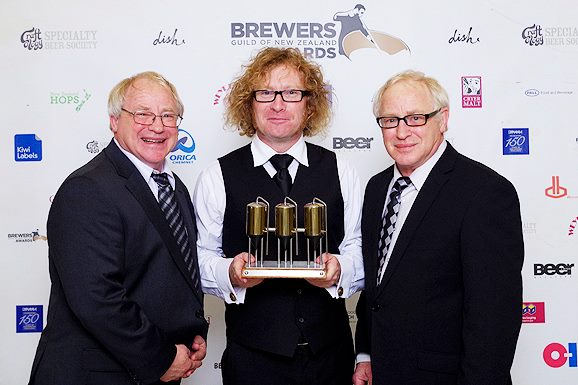
The second photo comes from the most recent time I had beers with Stu: the Brewers Guild Awards Dinner. The bathroom was right next to the photo booth, and on one of my many trips to it (the bathroom that is) I saw Stu getting his photo taken with this haul of Medals.

“Dylan, come here. Bite this.”

Credit: The Brewers Guild of New Zealand

Credit: The Brewers Guild of New Zealand

‘This’ was the Gold Medal Yeastie Boys won for Gunnamatta and contrary to popular opinion, not a pickle.

There’s a shared quality in these photos that for me, sums up why I love Yeastie Boys: because they’re odd and unusual, irreverent, even perhaps a little facetious. But always, always, well executed.

There was four years between these photos. It’s nice to see that some things change, but some things stay the same. Here’s to five years of Yeastie beers.

Zum Wohl!

*
*
*
*
*

Ok, one more photo:

Fuck'n. Classy. Bastards. Credit: The Brewers Guild of New Zealand.

Fuck’n. Classy. Bastards.                                    Credit: The Brewers Guild of New Zealand.


The Brothers Banks

The hangovers from Choice Beer Week should be well and truly forgotten by now and we can look back fondly on a week of excess and celebration. Myself, between avoiding Beervana like the plague (as either a worker or a punter) and closing Goldings at midnight I had one of the easiest Beervana weeks since I started working in the beer industry.1

Which isn’t to say I didn’t live it up and have a bloody good time. And my highlight of the week would have to be the Annual BrewNZ Awards dinner, where every yeah they dole-out trophies and medals to the brewing industry like candy at a kids birthday party.2 This year’s lolly-scramble was particularly gratifying, as I got to watch several friends and acquaintances receive awards, including our chums at Renaissance Brewing, who took out Champion Brewery (which I had actually predicted a few days earlier). Good stuff.

There was however, one rather odd moment in the evening, when they announced the winners of the Morton Coutts Award for Innovation. Now this is a hotly contested, but rather vaguely defined award. The previous winners are Stu McKinlay, for inventing a new, never-before style of smokey-death-beer and Jim Pollitt, for erm, well… I’m not actually sure. Near as I can tell, he actually spent most of his time undoing (de-innovating?) the damage done by Morton Coutts and his Continuous Fermentation.

So we were all on tenterhooks to hear who would take out this most prestigious award. And the winner is: Doug and Jim Banks. Um, who? Everyone looked around confused as as a pair of mature twin brothers got up from the DB Breweries table and wandered onstage looking for all the world like Tweedledee and Tweedledum in suits and ties. Ok, so who are these guys we asked? There was a brief thank you speech, which consisted of pretty much only the words “thank you,” and they left.3 No further explanation. We were just left to speculate.

So the evening continues and the ceremony takes a break. I slip out into the foyer to visit the bathrooms and who should be having their photo taken with their shiny new trophy? It’s Tweedledee and Tweedledum!

Doug Banks, Te Radar (MC) and Jim Banks.

Doug Banks, Te Radar (the award’s MC) and Jim Banks.

I spotted my chance and when the photos and interviews were over and they turned to go back into the hall, I slid between them and the doorway.

“Hi,” I said. “I just wanted to say congardulations on the award. I was wondering if you could tell me what you innovated?”

I got blank looks. And then they told me.

Now a warning: a lot of what they said was about brewing science. I’m neither a brewer nor a scientist, so I may get a few details wrong here. I tried doing a little research on the brothers and got in touch with the Brewers Guild if they could give me anymore details. They linked me to this article on the brothers, which gives the basic facts, but no extra details. I also got in touch with DB to see if they could give me more info. They linked me to the Brewers Guild. Thanks DB.

I’m not a journalist, and I didn’t take notes, so I’m working from memory here, and I should point out I was a little drunk at the time. So apologies for any factual errors I make. Here goes:

Mr Banks and Mr Banks have been working for DB for decades in technical and scientific capacities. They worked with Morton Coutts developing Continuous Fermentation. Coutts had invented this process, they said, and it fell them and their team to figure out how it worked and how it might be improved (there was more on this subject to come). Now I’ll be honest: I’m not keen on CF. I’ve never had a CF beer that I thought tasted any good. But hey, it’s pretty neat science, even if it makes bland beer.

So what else had they worked on? Micro filtration. Ah! Now we’re on firmer footing, beer wise. They apparently helped develop a process that made sterile micro-filtration possible, which is now used in breweries around the world. Now again I’m not a huge fan of filtering beer, but it can be a useful tool for brewers trying to clarify and increase the shelf life of their beer. Certainly it’s nowhere near as bad as pasteurizing it. Neato.

At this point the conversation was jumping all over the place: low alcohol beer. They helped develop a process that makes it easier to brew low alcohol beers. Again not particularly something I’m interested in, but the science as they explained it to me was pretty sweet. Something about a permeable membrane.

Then we got on to what seemed to be their favourite subject: yeast. It seems a lot of their work has been centered on isolating yeast strains in the CF system. As I understand it, because CF breweries don’t have the same turnover of yeast cultures and entire-system clean-outs that comes with batch brewing, if an undesirable yeast strain gets into a CF system, it can cause a lot of problems. Now isolating yeast strains is something I’m very interested in. Afterall, this is what gives us all the different strains of yeast you find in your local homebrew shop. And er, Beard Beer.

Something I found very refreshing out the brothers is they made no bones about the fact that they worked for a corporate giant, but they did hasten to point out that they weren’t just about the mega-beer. They also help out the little guys when they need scientific assistance. Apparently they helped sort out yeast issues at the Shakespeare, back in the day.

So I chatted about yeast-strains and brewing processes with the Banks brothers for a while. At this stage however, I REALLY needed to pee, so I made my excuses, congratulated them again and went about my business. And back at the tables I told everyone about the two nice gentlemen scientists I met, the ceremony resumed, and that was that. Or so I thought.

The ceremony wrapped up in due-course, and I was chatting to Dave the Beer Guy, when out of nowhere popped Mr. Banks (I’m afraid I couldn’t tell you which one). There was something else, he said, that he forgot to mention. And then he started talking about, and really couldn’t make this stuff up: bioluminescent rabbits. It was something to do with yeast isolation again: giving rabbits different samples and using luminescent indicator when certain strains were present. Assuming no rabbits were harmed in the process, that’s a pretty cool piece of science.

And so the conversation rambled on again. Mr. Banks told us about a design of theirs that’s used in one of the largest breweries in Europe and about a brewery he’d worked on in Africa that wastes very little water. We both agreed that that’s the way New Zealand breweries should be working towards, both for environmental and economic reasons.

In fact if there was a consistent theme to our discussions it would be making brewing more efficient. And I’ll be honest: the motivation for this is mostly financial. People like the Banks brothers work for DB because they save DB money. They mean DB can more efficiently churn out their bland, homogenous products. But I still salute Mr. Banks and Mr. Banks for their work because it has a roll-on benefit for all sectors of the industry. Efficiency (whilst maintaining quality) should be a goal of all breweries, no matter what scale.

Our pleasant chat with Mr. Banks finally ended when we were ambushed by the video camera and we had do our darndest to look sober for an interview. Still, I thank the Brother banks both for their work and for taking the time to explain it to me. I get the impression not many people ever ask them what they do or are very interested in the answer.

To Mr. Banks and Mr. Banks: Gentlemen Scientists of the Brewing Industry.


1. In fact I kind of feel like I got off too easy this year. Previous years I’ve been an absolute wreck after working too many 14+ hour days straight.
2. Although some years they’re stingier with medals thank others and the goody-bag you take home after the party is a bit light.
3. Thre were some other things said, but we couldn’t hear them because of the PA system, which was bloody awful.

Film Review: Beer Hunter the Movie

Those with a long-ish memory might remember back in early 2012, Dom at Hashigo was attempting to raise funds for a documentary on the late Michael Jackson. No, not that one, the other, beer-related one. The one who’s known as the world’s greatest beer writer. The one known for pretty much inventing modern beer style guidelines and for introducing Belgian beer to the Belgians.

Beer Hunter

Well, now the film is finished and SOBA organised a screening at the slightly absurd Roxy cinema in Miramar. So how’d it turn out? Well for one, I definitely went with the right audience. Only a hundred-odd Beer Geeks would chuckle at quips about yeast strains and beer marketeers. And in this regard, I’m not entirely sure how wide an audience this film is going to have. If I didn’t already know and care who Jackson was, it might have been rather slow to watch.

So this is one for the Beer Geeks. Fortunately, I am a massive Beer Geek, and this film was right up my alley. Indeed I found this to be an utterly charming little film about an utterly charming man. Jackson comes across as exactly the type of guy you’d like to meet at the pub for a pint. Modest, knowledgeable, quite the conversationalist and most of all, brimming with passion.

And that’s what this film captures brilliantly: his gentle exuberance and love for all things beer-related. I feel like I got a real insight into Jackson and I even felt an unexpected rush of sadness when it came to his death.

My favourite moment of the film:

Czech Brewer: “They want to sell it in Britain, but they want to re-label it as an ale.”
Jackson: “They want to sell your lager as an ale? Tell them to fuck-off. You can’t sell lagers as ales.”
[Big laugh from the audience]

So this film is definitely a great watch if you’re familiar with Jackson’s work, or even just interested in beer geekery in general. Now if I had to criticise (and you know I do), I’d say the film was rather poorly shot and edited. The camera work at sound is at times infuriatingly bad, to the point of distraction. But then this is a low-budget, amature production; so we should forgive the hallmarks of cinéma vérité.

Perhaps the most perceptive comment on the film though, came from my fellow bloooger Denise. She pointed out that this movie ‘Came too late.’ Throughout the film we’re watching a rather decrepit (for want of a better word) old man who looks closer to 80 than 65. It comes out during the course of the film that Jackson had secretly been suffering from Parkinson’s Disease. It is however, clear from the start that there’s something not entirely right with the fellow.

I can’t help thinking it’s a real shame this film wasn’t started 10-15 years earlier, when Jackson was much more in the swing of things (although the film makes it clear he never slowed down). Still, I guess that’s the way things happen in life. And the fact that Jackson himself never lived to see it completed does serve to make a point about unsung heros.

Verdict: Definitely a great little film if you’re self-style Beer Geek or interested in Jackson’s work. Both the film and the man charmed me utterly.

Moa Brews Up Fresh Controversy

So I noticed this piece pop on Stuff and thought it was worth sharing. I look forward to the comments…


Moa Brews Up Fresh Controversy

DYLAN JAUSLIN Last updated 15:43 11/07/2013
The advert in question.

The advert in question.

Blenheim based brewing company Moa, has attracted fresh accusations of sexism with  their latest print advertising campaign. The new ad (pictured), which has appeared in several men’s special interest magazines, features the legend “F*** bitches, get money” next to a bottle of beer and above the New Zealand Olympic logo.

Commentators on social media sites Twitter and Facebook have condemned the ads as “horribly misogynistic”. The phrase in question comes from the 1995 gangsta rap song Get Money, performed by rap group Junior M.A.F.I.A. and sung by late rapper The Notorious B.I.G. Gangsta rap is a genre famous for violent and sexist lyrics.

Twitter users have been lampooning the advert by suggesting Moa should start line of sexist t-shirts, using the #MoaTShirtIdeas hashtag and mash-ups of other Moa slogans. User @squirrel_fight tweeted “Because not everyone is a female person” #MoatshirtIdeas. This is in reference to another of Moa’s slogans.

Representatives of Moa were quick to step in and defend the advert. “Accusations of sexism are unfounded” said a Moa spokesman. “Despite sailing a little close to the wind in some previous marketing campaigns, we’ve never set out to offend anyone for the sake of cheap publicity… We would be shocked to think anyone would see this as part of our strategy,” he said.

Josh Scott, the Auckland-based alleged Head Brewer of Moa was also quick to respond: “It’s meant to be light-hearted and tongue-in-cheek. People take these things way too seriously. It’s not sexist. I asked my Mum”. Josh’s mother, Catherine Scott, Winemaker for the Allan Scott Winery and Blenheims foremost feminist thinker, was unavailable for comment.

Moa investor and CEO, Geoff Ross took a different approach when brushing off criticism. “We’re trying to build a brand here. We’re trying to create a sexy and stylish image for Moa,” says Ross. “Our beer is the domain of aspiring, affluent men… Women should realise the ad appealed Moa’s male market,” he said. 

“We want our brand to be synonymous with New Zealand.”

Ross also defended the advert, saying that “It rather neatly encapsulates the philosophy and approach of Moa since my involvement in the company.” Ross’s Business Bakery bought into Moa in 2010, after selling off New Zealand’s famous vodka brand 42 Below to Bacardi.

The question of sexism has remained unsettled. However fresh controversy surrounding the advert arose yesterday, when it fell into the hands of the Warner Music Group, who owns the rights to The Notorious B.I.G.’s music. Warner has accused Moa of infringing on their copyright of the Get Money lyrics and has demanded royalties for their use.

Moa was again quick to respond in their usual manner, by sending the Warner Group an insulting postcard. The card features an image of American nuclear test at the Pacific Marshall Islands, as well as an anti-nuclear stamp and a rude message in Maori.

Moa-Response-2-Portrait-Address-HiddenThe repose from the Warner Group has been one of confusion. “We don’t really understand,” said a junior Warner spokesperson. “Warner has never been complicit in the testing of atomic weapons. Frankly, it’s a bit of a non-sequitur.” He was also herd to ponder: “Are New Zealanders all this rude?”

 © BN Media.


*

*

*

*

*

*

*

*

*

So this is obviously a parody-piece. If you haven’t figured that out, then you’re probably a bit of a spanner. I would like to dedicate this post to The Civilian, one of the finest news parody sites I’ve ever seen.

A Different Kind of IP Issue

I heard something interesting over the bar a while back. That’s a great start to a bloooog post isn’t it? So it wasn’t anything bad, just something interesting. And it went a bit like this:

“Have you heard about this West Coast brewing competition they just had at Malthouse?”
“Nah, what’s that all about?”
“You brew an IPA and the guy who won, he gets made for him by some brewery up in Newlands.”
“Is that right?”
“Yeah, but here’s the thing: you don’t get a share of the profit. So some other bastard gets rich off your beer.”

Now, that is something interesting. “Some other bastard gets rich off your beer.” In this case, the brewery is the newly opened Baylands Brewery and the bastard is the rather pleasant Mr. Aidan Styles. Now anyone who’s spent any real time in a small scale commercial brewery knows that no brewer in this country is getting rich in a hurry. Indeed, it takes roughly 20 years before you can expect a good solid return on your work.1

So to me this idea that someone should receive the profit made from a batch of beer where they provided the recipe is a bit naive. Certainly if they bought the ingredients, rented the tank space, actually brewed the beer (or paid the labour), paid the excise and then distributed it, that would make sense. But then there’s a name for that: contract brewing.

But then I got thinking. You know what? Maybe there is something to this. Recipes are a form in intellectual property, right? Use of someone else’s IP in other fields usually requires payment. That’s why we have copyrights, licensing and all that business. After all the author of a book receives a percentage share. Why not the author of a beer?

This got me thinking even more: How much? How much would recipe royalties for the batch of beer from the Amateur West Coast IPA Challenge amount to? Lets find out. The book analogy seems apt. lets go with that.

I got in touch with a friend of mine in the publishing industry. In New Zealand, an author can expect to take about 12.5% of the retail price of the book (although it can be as high as 25%).

Ok, so that’s not going to work.

Dominic from Hashigo did a pretty neat breakdown of how much beer costs and why here (Table 3. in particular). Doing some hasty back-of-the-envelope arithmetic, giving a recipe maker 12.5% would increase the cost of beer by at least $2 per pint. I don’t think the brewer, the consumer or anyone in between would swallow that one. So lets find another model.

What about films then? That’s my area of expertise after all. If we consider beers like films, what then? Producers, directors, screenwriters and so forth can work for a flat fee, but they can work for a percentage of the film’s profits, banking on it being a hit. Using this model, a recipe maker would be roughly analogous to a screenwriter (if the brewer is the director, etc.). And what sort of percentage do screenwriters take? Well, that varies greatly, but using a lot of back-of-the-envelope work, from each movie ticket sold, probably less than a cent will go to the screenwriter.

Hmm. This doesn’t look promising, but lets stick with it. Now films can be watched again and again, but beer is finite. You make so much, it’s drunk, then it’s gone. So it makes sense in this regard, for a flat fee per batch, on a per volume basis. The total of this fee would therefore increase if the batch was scaled up (although the actual per volume rate would stay the same or eventually decrease from a certain batch size, due to economies of scale). You with me? Cool.

So what’s an appropriate per-volume fee for a recipe maker? All things considered, it’s going to be fairly low. It should probably be applied on a per-litre basis, but lets be generous. Beer is sold in ‘pints’, so let’s apply it on a per-pint basis.

Now Baylands has a brew length of 300 litres. We’re going to assume Aidan gets exactly that from his brewery, which means he gets six 50 litre kegs from a single batch. Now a ‘pint’ has different meanings to different people, but most ‘pints’ served in New Zealand are 425ml and for the sake of ‘best case scenario,’ we’ll go with that.

Now what’s a fair per-pint fee to the recipe maker? I reckon that’s about 1 cent per pint. Seems low I know, but the profit margins in beer really are narrow, and the amount per-pint that actually makes it back to the person who actually had to lift sacks of grain isn’t much more (and since breweries would pay the fee, it’s their profits we’re eating into). You still with me?

Now there’s 705.88 ‘pints’ to 300 litres, so that would mean that Aidan Styles owes to the winner of the Amatuer West Cast IPA challenge (who happens to be Ryan Crawford):

$7.06 (I rounded up).

That’s a cent for every pint you can theoretically squeeze out of Aidan’s brewery. That’s not enough for Ryan to buy back a pint of his own beer; particularly after tax.

So much for some bastard getting rich off someone else’s beer. Personally, if I was in Ryan’s situation, I be happy if someone just shouted me one.


1. Although no one told Geoff Ross that.

San Francisco – A Post-Mortem

So I’ve been in the States or more accurately California (or San Francisco, Santa Rosa and Petaluma to be exact) for a while, but now I’m back and at the keyboard. I’m not sure how best to write about my experiences, so I’m just going to ramble for a bit.

Flying economy from New Zealand to Cali sucks. I mean it really sucks. I’m pretty sure Dante describes circles of hell that are more pleasant than a transpacific flight. Anyway, after a shuttle ride, three flights, an air-train and a trip on the BART (underground rail), and a fair bit of legging it, we (I was travelling with my friend Hannah) emerged into Mission Dolores, San Francisco.

I have never felt a more profound sense of culture-shock in my life. I’ve been around the world. I’ve been to Australia. I’ve been to Western Europe. I’ve been to England, Hong Kong and Brunei Darussalam. I’ve even been to the States before (or at least Hudson, Wisconsin). But I have never been as shocked by a place as I was walking out onto Mission Street.

It wasn’t so much the foreignness of Mission, as how much it differed from my expectations. Frankly I thought I must have fallen asleep on the underground and woken up in Mexico. English was the lingua franca but Spanish was the language most spoken and used on billboards and signs. Then there was the smell of the place. That weird city-smell: a mixture of frying foods, rotting vegetation and something sweet and vaguely animal. You don’t get it in New Zealand (except maybe in a couple of places in Auckland), but I’ve smelt it before, in Europe and especially Hong Kong.1

On reflection though, the smell may have been coming from the wall of homeless people that greeted me. I’m pretty sure that if you rounded up all of the homeless in Wellington, there would be fewer than are camped out on Mission Street. At a rough calculation, it seems that there is an average of 1.5 homeless per 100 meters in SF.2 It also seems you can’t just be homeless in the States; you also have to be gibbering insane as well.

Anyway, after a shower, a burrito and a lot sleep, things started to look up. I’m not going to do a blow-by blow of the whole affair. That would take too long. Instead I’m just going to give my general impressions, starting with the plumbing.

I have never seen such a bewildering array of tap mechanisms. The shower tap in the place we were staying seemed to work using a joystick principle, whilst the kitchen seemed to be more of a seesaw affair. The best one though, was a model I’d met previously in America: a knob that you rotated for temperature and pulled in and out for pressure-control.

Toilets were another matter. They seemed to work off a similar vacuum principle as those hateful aeroplane toilets, which was a lot less effective at cleaning off skid-marks than the cascading flush system.

Hannah, my travel budy with a pint.

Hannah, my travel buddy with a pint.

Bathroom fixtures aside, I spent most of my time walking a lot, eating a lot, drinking a lot and looking at very big things. And let’s face it; it’s the drinking that most of my readers are interested in. The bar-scene in San Fran is insane. I reckon I have a sixth sense3 when it comes to finding good places to eat and drink. It makes me able to find good bars and restaurants anywhere in the world. In SF, this sense was buzzing constantly.

Bar Highlights:

Toronado (Haight Street) – Obviously. People had been talking this historic and grungy dive for years. The surfaces were filthy, but the atmosphere was awesome. The bathrooms were horrific, but the beer was fantastic. Paul, my local contact made sure we were really taken care of there.

Paul at Toronado, in a tyupical pose.

Paul at Toronado, in a typical pose.

Zeitgeist (Valencia) – Again, very dive-y and quite historic. Sitting in a rather spartan “beergarden” (read: vacant lot with tables) listening to punk and metal on a Sunday afternoon was one of my beer highlights. Probably Zeitgeist and Toronado sum up the crappy-awesomeness of the American beer-dive.

On the wall at Zeitgeist

On the wall at Zeitgeist. Photo: HK.

Monk’s Kettle (16th Street) – Relatively costly, but very well executed Belgian-esque bar and restaurant.

Benders (Mission Street) – Genuinely a dive bar. We went there late on a rather sedate pubcrawl. My memories get hazy after the first pint of Pliny, but I do remember a woman telling us about her dog’s penis and being invited back to someone’s house for marijuana lifesavers (which we declined).

At Benders. Now that's Divey!

At Benders. Now that’s Divey! Photo: HK.

I may have been a little drunk.

I may have been a little drunk.

Public House (At&T Stadium) – When Paul said we should go to the stadium bar I was surprised, but the place was really good. A little bit corporate in feel, but they had 24 taps and very few slouchers on any of them. They even had some 8 Wired bottles.

And if I could sum up one of the best things about the bar scene in SF, it would be exactly that: very few slouchers. Even bars that have no pretension to being ‘craft’ or even beer-focused sever at least one or two good beers from regional breweries. Speaking of which…

Brewery Highlights:

Russian River (Santa Rosa) – Obviously. I made the pilgrimage to Russian River for my birthday. It was a little too busy to enjoy properly, the bar was a packed tight and it was a struggle to get served, but the beer was excellent.4

So was the Pizza.

So was the Pizza. Photo: HK

3rd Street Aleworks (Santa Rosa) – I found 3rd Street on the way to Russian River and stopped in for a beer or two. It was a pleasant little brew-bar, and because it was my birthday, they shouted me a round (so pretty much have to say nice things about them).

The brewhouse at Lagunitas.

The brewhouse at Lagunitas.

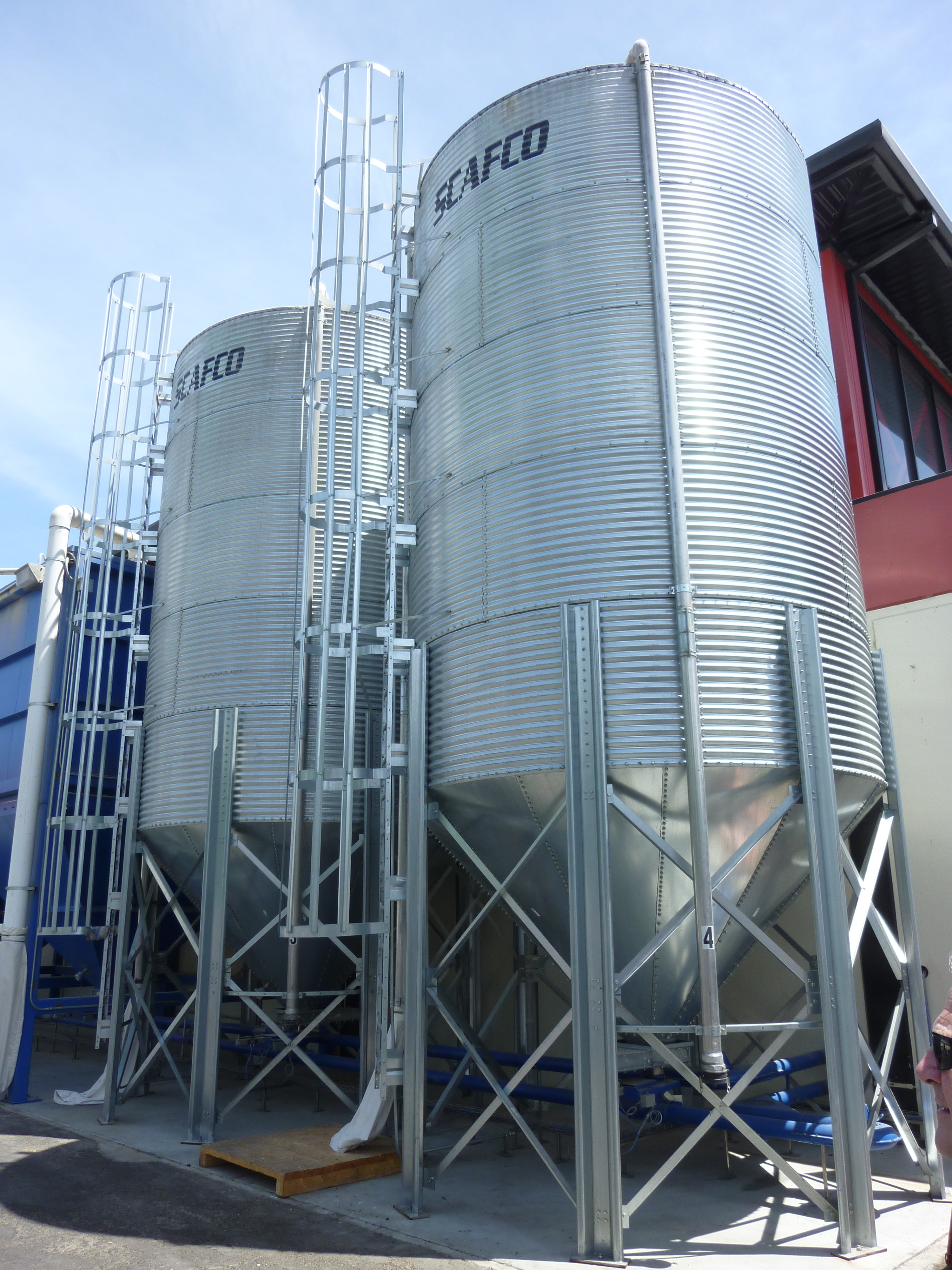
Lagunitas (Petaluma) – Obviously. I’ve had a few Lagunitas beers in New Zealand, and I can say that I didn’t have awfully much regard for them. But decided to check it out anyway. I’m very glad I did. Fresh Lagunitas beers are amazing. Completely different (and by that I mean better) from the stuff you get here. But what really struck me was the size of the place. Without a doubt it’s the biggest brewery I’ve ever been to. As you approach, there are two big tanks by the entry to the brewery. It though they were fermenters. Nope: grain silos. For each days basemalt. Just one days worth.

Those aren't ferments.

Those aren’t ferments.

THOSE are the fermentsers!

THOSE are the fermenters!

It’s brewing on a scale you don’t see in New Zealand outside the multi-national companies. But the beer is still amazing. That you can brew in such quantities but still make great beer is encouraging and I think, or at least hope, that I’m looking into the future of beer in New Zealand. One day we’ll be making beer on that scale, whilst still maintaining quality standards.

Magnolia (Haight Street) – let it never be said Americans only make high gravity hop bombs. It seems May is ‘session beer month’ at Magnolia. Of a flight of five beers and one cider, only two were above 5% ABV. I had an English Brown, Bitter and Mild Ale; all of which were stylistically accurate (euphemism). I also had a Porter, IPA and Pomegranate Cider (a guest tap) which were excellent.

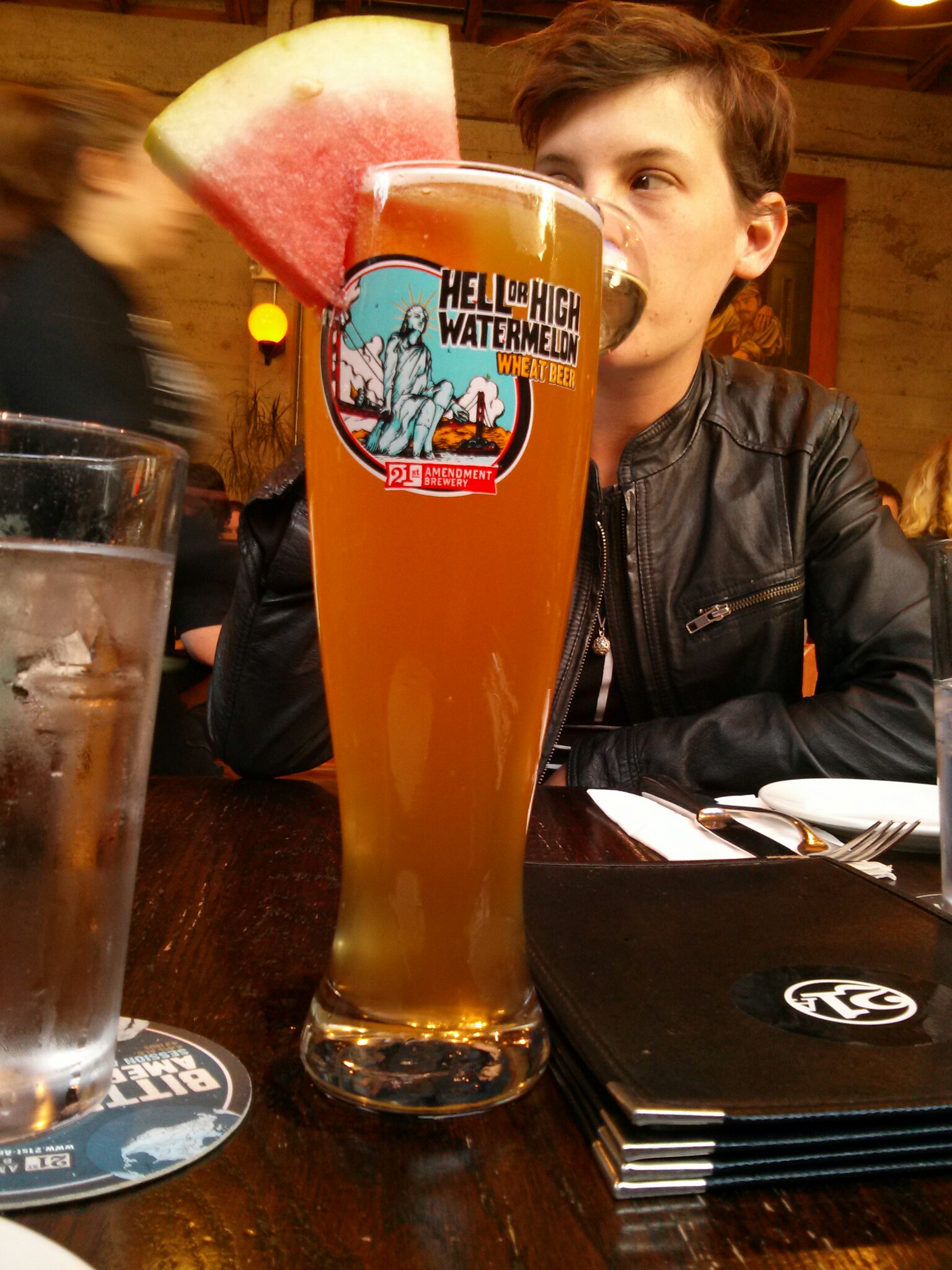
21st Amendment (2nd Street) – This is one that was talked up to me for years and didn’t disappoint. The beer was good, the food was good and the place was good. All around it was good.  Good good good.

Double Plus Good!

Double Plus Good!

Triple Rock Brewing (Berkeley) – I went on a trip to Oakland, but somehow ended up in Berkeley. A quick scan of the internet told me to go to this brewpub on Shattuck Ave. And it was nice. Nothing pretentious, and if the beers didn’t blow my mind, then they were still all really good.

Best experience in the States (beer or otherwise):

That would have to go my sunset sailing trip under the Golden Gate Bridge. The weather was lovely, the seas calm and the crew member an ex-pat Kiwi who chatted to me about sailing and the Oakland music scene.

Oh say can you see?

Oh say can you see? Photo HK.

Best of all though, the boat was stocked with Lagunitas IPA. I drank it from the bottle whilst the bridge soared overhead and the Sun sank into the Pacific. Magical.

Imagine this view, but with  awesome IPA in hand...

Imagine this view, but with awesome IPA in hand.

A Post-Mortem:

So what did it all mean, in the end? Sitting back in Wellington freezing my anatomy off it’s easy to look back on San Fran with a deep rose-tint to my specs. But reading over my notes there are a few things that occurred to me at the time which I think I should articulate.

First of all California is awesome, but I could never live there. Americans are wonderful people (as are all nationalities I’ve ever met), but there is a deep streak of something well fuckedup about American society. This is a beer blog, so I’m not going to get into heavy handed socio-political discussion. But I did notice it in small ways and it unnerved me.

Secondly, the beer itself actually disappointed me a first. You see I came of (drinking) age right in the renaissance of New Zealand beer, but I also grew-up on the legend of American microbreweries.  And I think the fault is mine: I was disappointed by American beer because I expected it to be earth-shatteringly,spectacularly, well… better. I wanted it to blow my mind and it didn’t.5 Certainly, specific beers (such a Torpedo) were much better than when I tried it in NZ. On the whole though, American microbrews were not generally any better than the product of New Zealand.

Yes, you heard me right: The best beers of New Zealand are easily the match of the best beers of America, or in fact, the world.  Now in saying this, I acknowledge that this wouldn’t have been true four, three, even two years ago.  New Zealand has come a very long way in a very short time. I would credit this to the rise of smaller, more adventurous brewers, be they contractors like Yeastie Boys or set in steel breweries like Garage Project. I would more importantly however, credit this to an upping-of-their-game by New Zealand brewers across the board in the last few years.

So I was a little disappointed that the beer didn’t shatter my world (I actually got over thus fairly quickly). But, and this is a big ‘but’, I still have to say in beer terms, America is at least a decade ahead of New Zealand. And I’ll tell you why: it’s not the beer, so much as the culture around it.

In New Zealand, I tell people I’m a beer enthusiast and they’re confused: Is that a thing? What, like Mac’s and Monteith’s? You work at a beer bar? How can you have a bar with just beer? Even in Wellington, I meet people who have never heard of Garage Project and only vaguely know of the likes of Tuatara or Emerson’s.

In California however, it’s the complete opposite: everyone knows about beer. I only had to say “I like beer” and people were tripping over themselves to give me advice. Oh you like beer? Have you been to Toronado yet? Let me tell you my favourite bar. Have you tried Pliny? There’s a place around the corner you should check out!

This was literally everyone I talked to. It’s not that America is a nation of Beer Geeks, it’s just that everyone knows about and appreciates good beer. Even those who don’t would say things like “Oh I don’t drink beer, but there’s a place on Such-and-Such Street. I go there for the wings, but they’ve a great tap selection.” And that’s really the thing. It’s mainstream in California. Like I said about bars: there’s no slouching. Every good bar serves decent beer and every decent drinker appreciates it.

And like I said about Lagunitas, I can’t help but think that I’m looking into New Zealand’s future here. There will come a day, maybe less than ten years away, where every decent bar in New Zealand serves good beer. Where you can ask anyone on the street “where do I get a good beer” and they won’t be confused, but keenly point you to the pub.

One day.

I close now knowing that my time in San Francisco is over, but my business there is unfinished. There were bars and breweries that went unvisited, beers that were left un-drank and good times that went un-had. So what I’m saying is, stay sexy San Fran, cos I’ll be back.  

One last bridge shot.

One last bridge shot.


1. I’m told that since China took-over, Hong Kong has lost its whiff. I must get back there and find out.

2. Distribution is uneven though. Posh quarters like Richmond have practically none, whereas places like the Tenderloin and Mission Street have one every 20 meters or so. I noticed rich places like Union Street have no benches or convenient places to sit. I think they’re afraid that if anyone sits down for too long, they’ll sprout a shopping trolley full of booze bottles and start asking people for change.

3. Or eleventh sense, depending on your reckoning.

4. Speaking of which, yes I had brewery-fresh Pilny the Elder and yes, it was good. You know what though? I liked Blind Pig better. Pliny has a massive cult following, but Pig is I think, pretty underrated compared to it’s bigger brother. Just say’in.

5. This might be why I was underwhelmed by Pliny. Certain beer writers have been talking it up for years, building a myth that doesn’t quite tally with reality.

Um, what the fuck is this? At the Rogue Public Ale House.

Um, what is this? At the Rogue Public Ale House.

Attack of the Lager Lout

So regular readers (if I have such a thing) may have noticed a decrease in my posting frequency.  With the opening of Golding’s I’ve had a noted lack of time and will-power to write anything.  Speaking of which Garage Project Major Goldings was a smash hit with the 30 litres lasting about an hour.  The beer turned out kind of like a hoppy-wheat-ESB; quite drinkable and a little odd.

Anywho, posts are about to get even less frequent, as I’m off on an short beer-research trip to San Fran, taking in GABS on the way back.  This’ll probably be my last post for a few weeks, so I thought I’d better make it a good’um.

Those active on the more beer-y section of the Twittersphere may have noticed this conversation going down (click for a larger version):

Click for a full sized version.

Take a moment to read that, it’s quite the rant.  It’s something I’ve encountered before too.  Every now and again you meet a customer that insists that:

A) Pilsners are not lagers (they are), and
B) Beer Geeks are a some sort of breed of lager-hating fascist-nazis.

I experienced this several times at Hashigo, records of which exist here, here and here.  The usual complaint was that either the staff at Hashigo wouldn’t serve lagers, which was odd, because there’s always one on tap and several in bottles, or that we would mock anyone who dared order one.  Again this is odd because why would we serve something if we didn’t want people to order it?  Indeed the idea we would mock every person that ordered a lager is pretty ludicrous, because tap pils was our biggest seller. More to the point if I’d taken the time to mock every lager drinker, I’d never have had the time to get anything done in the day.

Anyway, back to the issue at hand.  My personal experience of this was much similar: a chap came up to the bar one busy weekend at Hashigo and ordered a lager.  We had some sort of pils on tap, and I recommended it to him.  “I don’t want a pilsner, I want a lager,” he said.
“Pilsners are lagers,” I said.
“No they’re not,” said he.
“Actually they are, you see it’s a matter of yeast…” and I launched into an explanation of yeast varieties and the taxonomy of lagers.  Hell, I’d have pulled out map and shown him Pilsen if he wanted to see it.

However, it wasn’t to be.  I noticed very quickly not only his attention but also the will to live sliding off his face.  Sometimes when you need to temper your enthusiasm when talking to non-Beer Geeks.  So I gave him the short version: “Take it from me mate, pilsners are a type of pale-lager that originated from Czech town of Pilsen.”
“Alright, I’ll take one of those then.”  And all was good again.

Or so I thought, until I went to go clear some glasses and walked past his group.  I watched him take a swig off his beer and grimace.  “Fucking bartender.  He tried to tell me pilsners are lagers.  They’re so full of shit here.”

Listen buddy, my anatomy is not equipped with middle-fingers big enough for the likes of you.  I was seriously pissed of at that guy, but I didn’t tell him that.  In fact I let it all slide.  Looking back on it, it wasn’t that he didn’t know about beer styles or didn’t share my passion and geekery.  In the end, I resented him because he insulted my professionalism as a beertender.  Beer is my passion, and I bartend to share that passion with other people.  I’m good at bartending, and if each day I can help a customer derive the same pleasure from beer as I do, then I consider that a good day.

Back on track now and to my original point: pilsners are lagers and anyone who tries to say otherwise is speaking out the wrong orifice.  But what about Beer-Geeks hating lagers?  Well, for starters  it’s not true; I’ve spent the last three years serving lagers to the beer community of Wellington.  Secondly, most craft breweries make a lager and frequently it’s their biggest seller.  So this assertion that geeks just don’t like lager is utterly false.

That said, there is another issue lurking in the background like a bad smell: accusations of snobbery.  Certainly I’m no stranger to being called a snob.  I’ve even occasionally worn the badge proudly.  But it’s never a nice thing to be called and I also think it’s quite unfounded in most cases and especially with Roland and Brother’s Beer.

You see I’ve noticed a curious phenomenon in over the years working in a beer bar: if someone comes into a bar and asks for something you don’t have, they frequently can take it as a personal insult.  This happens most often with the big branded green-bottle lager drinkers and can be quite vehement at times.1  On more than one occasion I’ve had said to a customer “Sorry we don’t have [Heineken/Stella/Steinlager/whatever]” and had people react as if I’ve told them to go fornicate with their own mother.  In most cases I try to recommend a nice alternative, but frequently the battle is lost.  They either splutter “what’d ya mean you don’t have [beer XYZ], you’re a beer bar, what kind of beer bar doesn’t have [beer XYZ]?” or occasionally, they just walk out.

And then they send angry tweets.  Or post bad reviews online, calling you and your establishment snobs and wankers.  And what are you supposed to do in that situation?  You really can’t win.  What you should try to do is be polite and find them a beer they’ll enjoy.  Educate, don’t exclude.  And I think Brother’s made a fairly good effort to do just that (at least until the end, but hey, they’re only human) and I hope I do in that situation too.  But if they’ve already walked out, or like Monsieur Roland, won’t engage with the bar-staff, there’s nothing you can do.  They’ve excluded themselves.2

Now I’ve been thinking about this, specifically why this happens.  Why is it that some people take a bar not stocking a particular beer as badly as they’d take take an insult to their own mother?  I think the answer is a lack of understanding.  You see they just don’t understand a Beer Geek’s passion for flavourful, independant beers, and why they rail against bland corporate beer.  Not serving Heineken is to us a logical expression of our passion.  But to Roland’s ilk, it makes us mad, pretentious, snobs.  He just doesn’t get it and probably never will.

And you know what?  We’re all guilty of this on some level.  For example, take the British Cornish Pasty Association.  They’re passionate about pasties.  Ok, I can understand that.  But why do they declare carrots to be sacrilege in their official recipe?  That I don’t get.  To me that makes them mad, pretentious, carrot-hating pasty-snobs.  I just don’t get it and probably never will.

How about an example closer to home?  How about CAMRA then?  I will never understand what those guys have against carbon dioxide.  C’mon guys, some beers are better fizzy and cold.  Deal with it.  Frankly I think CAMRA (or at least elements of it) are a bunch of gas-and-lager-hating, elitist snobs.3  Is this starting to sound familiar?  I like real-ale as much as the next Beer Geek, but a slavish devotion to only cask-conditioned ales is to me frankly ludicrous.  I just don’t get it and probably never will.

So perhaps we’re all as guilty as Roland of not understanding each other’s passions.  Ok I take that back, we’re not because we don’t go making dicks of ourselves on Twitter.  And that I think, brings me sideways to the point I’m trying to make.  People have some odd passions and we all need a little patience and understanding with them.  Whether we be the expert Beer-Geek trying to explain why we don’t sell Heinie or the bewildered everyman who’s just trying to get a beer with a label he recognises.

Alright I gotta stop here, before I go full-hippie.  Peace and Love, ya’ll.

Also, pilsners ARE lagers, FFS!


  1. Although it can also happen with craft drinkers.  Not dyed-in-the-wool Beer Geeks obviously, but if I had a dollar for everytime I’ve heard an outraged “What’d ya mean you don’t have [Epic/Moa/Emerson’s/Renaissance/Green Man Tequila Beer]?”  Usually because it’s the only craft label they know and are comfortable with.  And no, I’m not joking when I say Tequila Beer.
  2. Although I did hear a rumour that this mysterious Roland allegedly works for a major liquor brand, which would put an entirely different spin on the whole thing.  I’m in no position to confirm or deny that though.
  3. Admittedly, my impression of CAMRA is probably poorly coloured by reading the comments sections on the Zythophile Blog and by small handful of members that have come into Hashigo and been utterly fucking rude, insulting, sanctimonious, knob-heads.  A large section of SOBA members are CAMRA members and good people.

Saluting the Major

So it’s been a big week for me.  The so-called ‘soft’ opening of Golding’s on Monday was a smash-hit, with the place packing out.  Since then it’s been busy every night and I’ve worked quite a few long days in a row.  The next big hurdle is the Grand, or what I like to call ‘hard’ opening tomorrow.  It’s looking to be another sell-out night, with half of Wellington inviting themselves along.  Feel free to pop along yourself, all are welcome.  Just don’t expect much in the way of elbow room.

An just to entice you down, we’ll be sticking a couple of treats on tap.  First of all, another keg of the Funk Estate/Baylands Brewery Big Red Ryeding Hood.  This was the darling beer of Monday’s opening: a big, malty, hoppy, rye-y IPA.  Very fresh and a little angry, but all the better for it.

The other beer, is something a bit different.  You see, I was at the Garage the other day (well, two months ago) and told Pete the Brewer about my new job at Golding’s.

Pete: “Congrats Dude.  Hey, we should make a beer for the opening,” said Pete.

Me: “You read my mind, Old Bean,” (or something like that).

Anyway, we got to talking and collaborating and so on.  Pete wanted to make something with lots of Golding hops (for obvious reasons).  I wasn’t so keen.  East Kent Golding is all well and fine as hop varieties go, but it’s not much fun in my opinion.  I wanted to do hoppy wheat ale.  As readers will know, I had a summer-romance with one a little while back.  Suddenly I had an idea.

Me: “What if we made an English Wheat Beer?”

Pete: “A what?”

Me: “What if the England had a traditional, native wheat ale?1  What would that be like?  Kind of like a bitter or a golden ale, but with a fair dose of wheat-malt and a clean British ale yeast”.

Pete: “I see.  Sounds interesting.”

Me: “We could hop it with lots of Goldings.  It’ll be like a English/German hybrid: British hops and yeast, but with German wheat malt.”

And so it was settled.  We booked in a brew date (no mean feat, considering how busy they are at the Garage) and off we went.

I turned up on brew-day at some ungodly hour (9am. That’s ungodly by my standards).  Pete was in the middle of brewing a batch of ANZAC on the big kit.

Pete: “Hey Dude, I’ve been thinking.  I like this English/German hybrid idea.  Lets expand on that and use a combination of English and German hop varieties.”

Sounds good to me.  We got down to arguing the malt bill.  I was keen to do a split malt bill 30-40% wheat with the rest Golden Promise, but Pete disagreed.  He reckons too much wheat can be a bit ‘yucky’.  I’m only a causal home brewer, and he’s the experienced professional, so I bowed to knowledge and experience on that one.  We went with a Golden Promise base, and 15% wheat.  Pete also wanted to drop in a bit of Caramel and Aroma malts, to make it a little more Englishy.  That fitted in with the concept, so I was down with it.

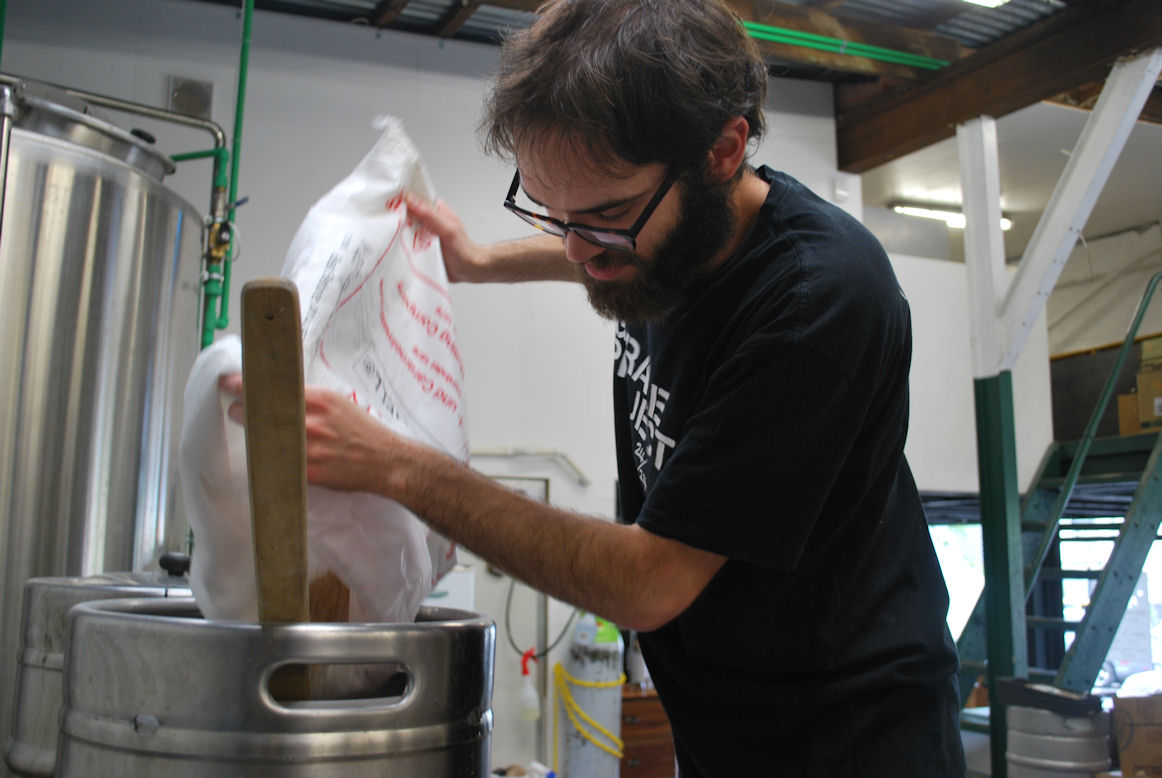
We milled, we mashed, we re-circulated.  All very standard stuff:

Mashing

I had my best brewing-face on.

Brewing faces may or may not contain beards.

Brewing faces may or may not contain beards.

I was a little concerned about the mash sticking, this being my first time using wheat.  I was there for the first Summer Sommer brew, which had an awful stuck-mash, that time from rye.  I could just envision a 10-hour brew day, but my fears were unfounded.  Everything went smoothly.

Like silk.

Like silk.

After running off, we got a healthy boil going, and started adding hops.  The same triple combo was used throughout the whole process: East Kent Goldings, Challenger and Hallertau Tradition.  A small  bittering addition was followed by generous late editions of all three hops.  I was measuring the hops, so I made damn sure they were properly generous additions.

As before, all went smoothly.  We boiled, we chilled, we pitched.  Yeast-wise we went with Wyeast Yorkshire Ale, a fairly clean and attenuative strain.  Soon the beer was tucked up cozily in a fermentor, bubbling away.  Easy as.

What wasn’t easy was coming up with a name.  Naming beers is tricky and often done poorly (I swear one day I will write that naming guide).  We kicked around a few names like “Free Diver” and “Dive-Bomber” but nothing quite seemed to fit.  Finally we settled on a suggestion of mine: Major Goldings.  This is both a tribute to Golding’s Free Dive, Golding hops, of which there are major amounts in the beer, and the British/German style mashup (because you know, wars and shit).

I haven’t had a chance to taste it post dry-hop, but early indications are that it’s refreshing and slightly bitter golden-ish ale.  4.3% ABV, light but full.  Now a word of warning.  There is only 30 litres or so, this being a pilot-kit brew.  It’ll be going on at Goldings on Friday, mid afternoon.  It will not last the night, so get in quick if you want to try some.

See you on Friday.  And remember  Beer is Love, ya’ll.

Sean and Pete

Pete and Sean, a pair of beardy-beer chaps.


  1. I’m ignoring the fact that they actually did and still do, sort of.

My Alcoholic Kitchen: Chickenosaurus Rex

So the other day I had beer-can-chicken for the first time.  And it was pretty good, but I’m not sure the beer did anything to the chicken.  Certainly I couldn’t really taste it.  Now I was in the company of beer geeks at the time (aren’t I always?) and we got talking about how to make the chicken taste more like the beer.

P1020651

Godspeed, you mad bastard.

We generally agreed that a good strong-flavoured beer would be best option, but what to use?  I wasn’t going to waste a good Imperial Stout or Barleywine on cooking.  I toyed with the idea of using more La Trappe but then someone suggested the obvious: Yeastie Boys Rex Attitude.  But of course!  So simple but so genius!

Now I have an interesting relationship with Rex.  I both love and hate it, sometimes within the space of the same glass and sometimes simultaneously.  Overall though, I’m fond of Rex.  Not because I like drinking it, but because it’s utterly-nutterly-butterly bonkers.  It’s unique and it’s insane and for that I’m glad it exists.1

So I resolved to making rex-beer-can-chicken.  Now there’s an obvious problem with this plan, which is that Rex doesn’t come in cans.  I got around this simply by purchasing another canned drink, emptying it and filling it with Rex.  For aesthetic reasons, I wanted to use a can of something really shitty, like Lion Red, but I was at the supermarket, and I could only really get cans of fizzies, so I went with lemonade.

P1020648

There’s no way this can go wrong.

Methodology:

  • Drain the can of lemonade/other beer/whatever.  Drink this with ice, Gin and a squeeze of lemon (optional).  
  • Season your chicken with a little oil, salt and fresh-ground pepper.
  • Fill the empty can halfway with Rex Attitude.
  • And er, well…  Shove it up the chicken’s bum.  Yup.
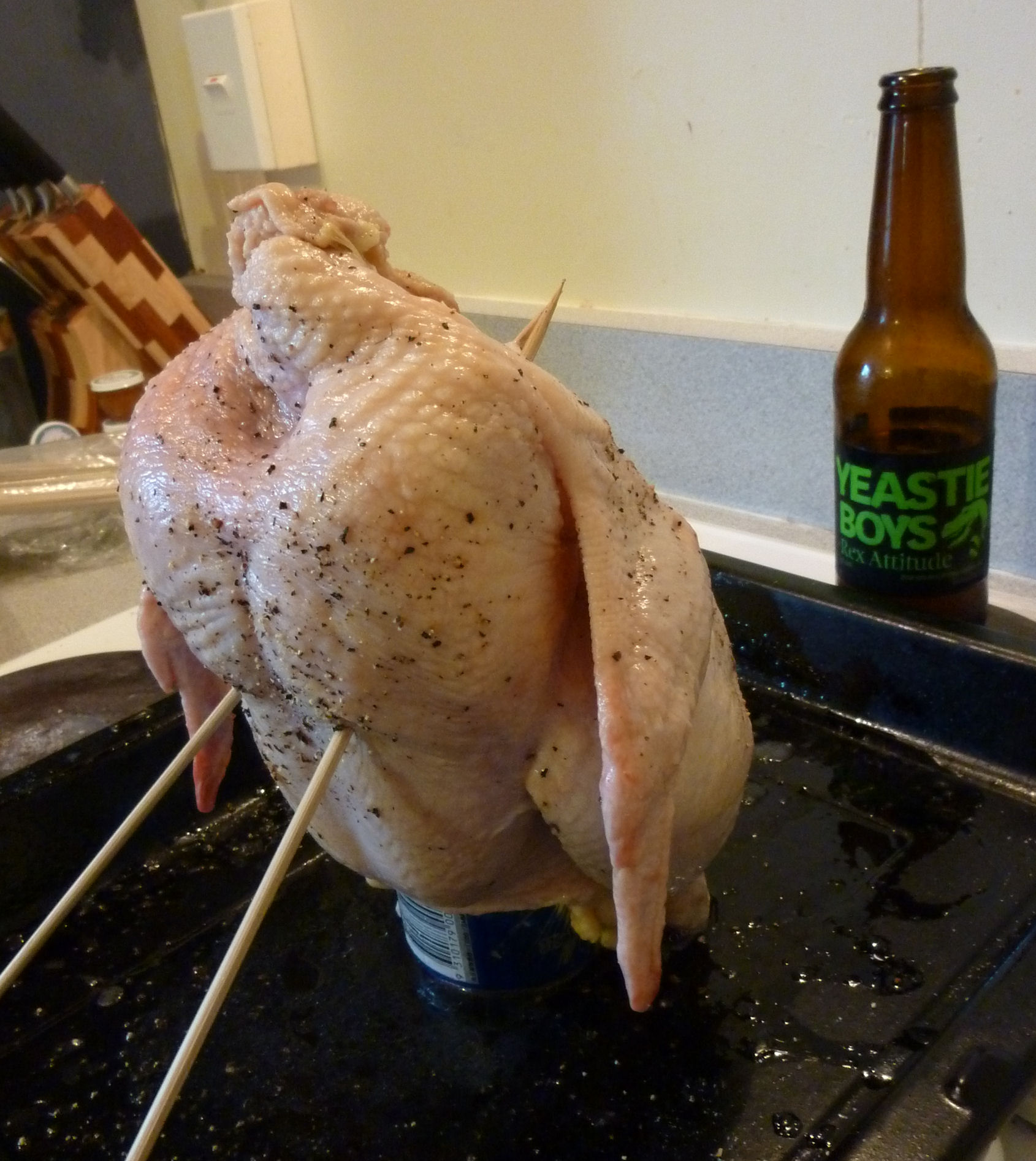
  • Stand the chicken on the end of the can.  Now I had trouble keeping the chicken upright, so I used a couple of bamboo skewers to keep it standing:
I'm probably not.

Do you ever find yourself wondering if you’re completely ‘normal’?

  • Now roast it in the oven/bbq for however long (according to weight) at whatever temperature (according to oven/bbq or whatever).  

I was going to drink the rest of the Rex, only needing half the bottle to fill the can.  But then a thought occurred to me: gravy.  I got busy preparing some spuds.  Very quickly, I knew something was different from a normal roast chicken.  A smoky, slightly burning smell started permeating the kitchen.  I think it was just some spilled Rex on the roasting pan boiling away, because it disappeared fairly quickly (or I got used to it). It was sort of pleasant, but also vaguely reminded me of stale second-hand smoke.

Anywho, an hour and a bit later and after putting on the vegetables, the chicken was ready.  I pulled it out and set it aside to rest.  Frankly, it looked a little scary.

RAWR!

I dub thee “Chickenosaurus Rex”!

I then got busy with the gravy.  Now I’ve heard it said by Christians that if God gives you a gift, it’s your duty to use it in the service of the Lord.  If this is true, I should probably give up beer-tending and become an Evangelical Gravy-Preacher, because my gravy is god-damn magical.  I’m known amongst my friends as the Gravy Wizard and I’m frequently contracted to make gravy at parties.

Now lets get one thing straight.  Repeat after me: “Gravy does NOT come from a packet”.  Got that?  Cool.  Here’s how I made gravy:

  • Take your pan with all the lovely drippings from the roast.  Pour them off if there’s a lot sloshing around in the pan.  Otherwise, put it on the stove top and turn it to low.  
  • Sprinkle flour into the pan a little at a time and whisk it about until you’ve soaked up all the liquid.  It should make a thick paste when all the oil has been soaked up.
  • Once the flower is looking all nice and browned, add more liquid a little at a time, while whisking to thin it out.  I used Rex.  It turned out I didn’t need to save the rest of the bottle because there was still some left in the bottom of the can from the chicken’s bum.
  • After a lot of whisking, the gravy should look nice and glossy.  If you’ve whisked it enough, there shouldn’t be any lumps.  I seasoned it with a little soy sauce, lemon juice and fresh-ground pepper.

So how did the Chickenosaurus taste?  Well, only the meat nearest the can had picked up the Rex flavour.  That was probably a good thing though, because it wasn’t particularly a good combination.  It wasn’t bad per-se, but it did kind of taste a little like I’d used cigarette ash as a spice rub.  Oh well.  It was a neat experiment and we lives and learns, doesn’t we?  On the other hand…

The Rex gravy was delicious: rich, subtly peaty and a little tart from the lemon juice.  It was great on the chicken but I suspect it would be even better on beef.  So the experiment was worth it in the end.  Rex gravy: I’m going to remember that one!

I’m not entirely sold on the whole beer-can-chicken idea.  The meat was very moist, but I suspect a broth or even a brine would work just as well.  Next time I might just baste the chicken frequently in beer.  Maybe a Rauchbier like Smok’in Bish or Smoko.  Then again, they do have guinea fowl at More Wilson’s.  And quails.  And I was looking at those extra small energy-drink cans at the supermarket…


  1. I’m also very fond of Rex Attitude for another reason.  If you give it to someone who’s never had it before, they’ll pull a funny face.  But also, be they beer geek or complete novice, there’s roughly a 50-50 chance they’ll love it/hate it, which is pretty remarkable.  Although I have seen more than one beer geek type pretend to love it so as not to lose face in geek circles, then abandon or dump it when no one is looking…

Green on Grey

Last Monday I had to be somewhere super early.  When I say super early, I mean 8:30 am.  Now I know a lot of you will be snorting into your pints “that’s not early.”  Well bear in mind that when your normal bedtime is 3 am, you have to sleep until 11 just to get your solid 8 hours.

There’s a reason we call you guys Day-Walkers.

Here’s a poem I composed on the bus, sometime around 8:15 am.

Sitting on the bus.
It’s too early for me.
I feel like shit.
It’s too early for everyone.  

The weather is grey.
The people are grey too.
Everyone’s grumpy.
No one smiles.  

Except for one:
A girl with green hair.
Sitting three seats back.
Rocking out with headphones.

She made me smile too.

I know this isn’t isn’t a beer-related post, but what’s the point of having your own piece of internet if you can’t do what you like with it.  Anyway, I’m cooking up an alcoholic post as I speak so look out for that soon.