I Found… Something?

Have you ever been doing an absolutely mundane task and suddenly stumbled upon something utterly weird? Like can’t stop thinking about it, can’t look away weird?

Recently I was trying to find the website for Tuatara Brewery. Now that was difficult, because they don’t actually have one, rather they have a page on DB’s website. But searching for Tuatara’s website led me to a completely different place. A weird place. A place that just doesn’t make any god-damn sense. A website called organicbeer.co.nz.

I’m not going to link to that page. At time of print it’s still there, but don’t go visit it for reasons that will become clear. This website struck me because well, almost everything on it was wrong. Not just factually wrong, but weirdly wrong.

Organicbeer.co.nz bills itself as a “travel blog about New Zealand Beer” which is a weird choice of URL for a travel blog. Then there’s the title of the website “Mikes Brewing”. Now if you’re of the same vintage of ‘craft’ beer nerd as me, that means something to you. Mike’s was a brewery in Taranaki, and they did indeed make organic beer. Mike’s went into receivership in 2017, and through a series of changes and restructuring, became a bistro in New Plymouth, which still exists to this day. So why then is this website pretending to be Mike’s Brewery?

And it is definitely pretending to be the Mike’s Brewery. On the website’s menu is a dedicated tab and page profiling Mike’s Brewery, that does reference the brewery’s old location, but doesn’t mention that the brewery has moved and no longer makes beer. This is very strange. I just couldn’t shake the feeling that something was very off but I was also kind of hooked. I wanted to know: What am I looking at here?

At this point, I noticed a page called “NZ’s Top 100 Beers: A Brief Overview”, published October 2, 2023. I decided to give it a read and let me tell you, it’s weird. For starters this is supposed to be a ranking of top beers in NZ but it has a lot of extra guff:
And these extra sections are full of platitudes about beer and brewing that are so generic, they’re almost meaningless:

OK, fine. This person isn’t a great writer. Lets get to the list. It’s organised by beer style, with a desciption and an example of a beer that fits said style. This is a little bit of an odd way to do it, but whatever. Let’s give it a chance. Trouble is, this list is full of things that are simply wrong:

Garage Project Hāpi Daze is not a Saison. This sort of error kept happening as a I scrolled down the list. Does the person who wrote this actually understand anything about beer styles? Many beers were filed under the wrong style category and some beers were listed that I’m sure were no longer in production when this article was written, sometimes from breweries that had closed years previously. I had a realisation: I don’t think this list is written by someone with a poor grasp of beer styles. I don’t think it was written by anyone. I think it’s AI.

I suspect this was created by someone plugging a prompt into ChatGPT (or similar) such as “Write a list of the top 100 beers in New Zealand by style category”. The AI in response has gone to the internet, presumably Untappd and the now defunct RateBeer and scraped a list of top beers in New Zealand, smashing it together with a list of beer styles. Where the two lists don’t match up – styles where there aren’t a lot of beers that fit the category, the AI made connections that don’t make sense.

A great example would be Bière de Garde. I doubt there’s more than half a dozen examples of the style in New Zealand, and probably none of them are ‘core-range beers’. So the AI chooses a beer that might have vaguely similar words in it’s tasting notes. In this case, Choice Bros Reet Petite, a Red IPA.

I started looking for a smoking gun – something that proved this list was wasn’t written by a person: an AI hallucination. It wasn’t long before I found one:

Tiamana Pils Dunkel is not a beer that ever existed. I know because I was indirectly involved with Tiamana. I was there when they opened in 2015 and I was there when they shut in 2018. At no point did they ever make a beer called Pils Dunkel, or even a Dunkel. This is a completely fictitious beer.

With all this in mind, I started reading more and more articles. Pieces with titles like “10 Must-Try Craft Beers in New Zealand”, “Exploring the Strongest Beers in New Zealand” and “What Is The Most Popular Beer In New Zealand”. These are all titles you might plausibly find on a lifestyle or travel blog. But if you actually read them, everything about them is wrong. Not factually wrong. The details are usually broadly accurate, but just somehow the articles are always just off.

For starters, the structure of the articles is weird. Almost every article has a table of contents, whether it’s warranted or not. They also end with a ‘Conclusion’ section and sometimes even an FAQ. It makes it feels more like technical writing, not lifestyle or travel writing.

Take “10 Must-Try Craft Beers in New Zealand”. It starts off with a weird table of breweries and mini bios called “Main Features”, which doesn’t feel right to me. Again, it feels more like part of an abstract or summary from a technical article. After that it goes to detailed bios, which again feel like more empty platitudes, stretched versions of the “Main Features”, with details pulled and re-worded from marketing material.

Garage Project, Epic and 8 Wired are the first three profiles, But for some reason 8 Wired gets a whole extra section, titled “The Spirited Rise of 8 Wired Brewing Co.” which is an almost exact repeat of all the info from the previous paragraphs. And I do mean exact, down to the sentence level. Here is the opening sentence of section one:

8 Wired Brewing Co., a beacon of inspiration for aspiring entrepreneurs and a shining example of Kiwi ingenuity and relentless pursuit of excellence.

And here’s a sentence of section two:

…embodying the essence of Kiwi innovation and tenacity, 8 Wired Brewing Co.’s journey resonates deeply with those harboring dreams of entrepreneurship.

That’s literally the same sentence worded two different ways. This feels like classic AI repeating itself – pulling information form articles and websites, shuffling keywords and subbing synonyms to endlessly recycle the same basic points.

This feeling really stuck with me. It felt like everything was made up of borrowed parts, cobbled together. Like I was looking at Giuseppe Arcimboldo’s painting of Vertumnus. Except instead of a clever collage forming an optical illusion, it’s a weird meaningless mish-mash that, try as you might, you just can’t make sense of.

This feeling peaked with the article “Unravelling Auckland’s Steam Brewing Secrets”. You would assume this is an article about Steam Brewing Co., the Auckland-based production brewery that makes beer under contract for many different breweries around the country, right? Not so.

This piece is about steam in the brewing process, as used by breweries in Auckland.
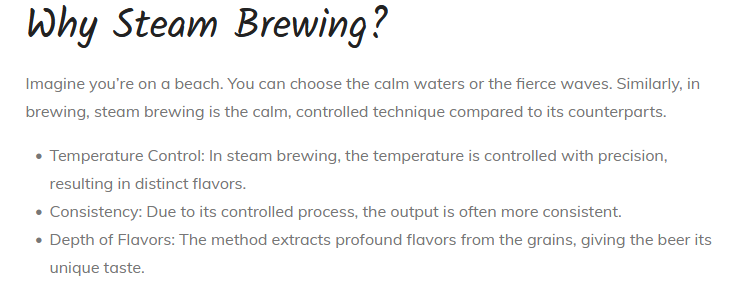
I suspect someone has prompted the software to write about Steam Brewing and confused, it’s spat out several hundred words of nonsense, including recommending visits to three breweries that I’m pretty sure don’t exist:
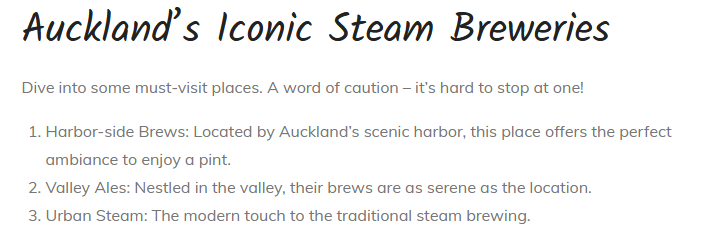
At this point, I think I’ve got the picture. Someone has made a fake blog about beer in New Zealand, probably using AI. Staring at my screen and feeling bamboozled, I’m left with many questions, chief among them: Why? What’s the point of all this? Is it a scam? It certainly feels scammy. But if that’s the case, what’s the actual hustle going on here? I start digging, maybe somewhere in one of these posts is this website’s raison d’etre.

I find myself looking at a list of recently published posts. So far, every article has been about NZ beer, but not the last five:

They’re still broadly beer related, except the second one. American Football? This article, while sort of about NZ it’s only tangentially related to beer. It’s mostly about watching American Football. But something else jumped out at me – there’s a link.

That’s when I realised: thus far, I haven’t seen a single link anywhere else on this website. This feels like a dog that isn’t barking. Surely if this is a scam, the point of the scam would be whatever this website is trying to push me towards, which has so far been nothing.

But now there’s a link. To the New Zealand TAB website. Gambling? Weird.

That’s when I remember the other recent article: The Perfect Pairing: Enjoying a Day at Hastings Races with a Refreshing Beer. There’s a connection there: races – horse racing – gambling. Was this the point? Some sort of asymmetrical marketing campaign for the TAB?

In a word – no. Because this isn’t an article about horse racing in Hastings, New Zealand. It’s about horse racing in Hastings, Vancouver, British Columbia, Canada. How does Canada fit in to all this? There’s another link on this page. But this time it’s a link to an Aussie gambling website justhorseracing.com.au, not the TAB.

On the one hand, I suspect this is AI making nonsense connections, but it also feels like the closest thing I’ve found to a pattern. I searched for a while to see if I could find any more external links but turned up nothing. A dead end.

Stepping back a bit to think about a new line of enquiry. If I can’t figure out the why of this website, maybe I should focus on the who. Each article has something I’ve thus far ignored: a byline. The author of this website is someone called Ross Walton.

There’s an about page too. And just like every other page on this stupid website, it contains a lot of words, but almost no information. As near as I can tell, he is apparently some dude who likes beer and has visited some breweries. That’s it. That’s the only biographical data to be found. But a name is something to go on, and there’s a picture too:

This might be useful. If I can find some other record of this Ross Walton and if I can match another photograph, maybe I can crack this thing.

The trouble is, Ross Walton is a very generic name. Only a few degrees less generic than ‘John Smith’. A simple search is going to reveal scores, maybe hundreds of Ross Waltons. So I try a series of searches.

“Ross Walton + Beer”, “Ross Walton + New Zealand”, and so on point me straight back to organicbeer.co.nz. Even filtering out those results I find multiple records of Ross Waltons, none of which I can positively ID.

Social Media is the same: FB, Insta, that other one, and LinkedIn. Too many results, nothing solid to go on. It doesn’t help that he looks like a generic, late millennial white-boy. That describes a pretty big chunk of the ‘craft’ beer demographic and yes, I’m in a glass house on this one.

I tried to get a bit clever and go the Companies Office. I’ve spent a lot of time tracing breweries and the people who own them through the through the Companies Register. Again, multiple Ross Waltons or variations thereof, but nothing verifiable. It’s the same for IPONZ.

I’m stumped. But I’m also looking at that photo. I had originally planned to see if I could find any other pictures of Walton and match the face in that photo. But what if I matched that exact photo?

I ran a reverse Google Image search and immediately found the original. And I can say it is the original, because the version on organicbeer.co.nz has been cropped:
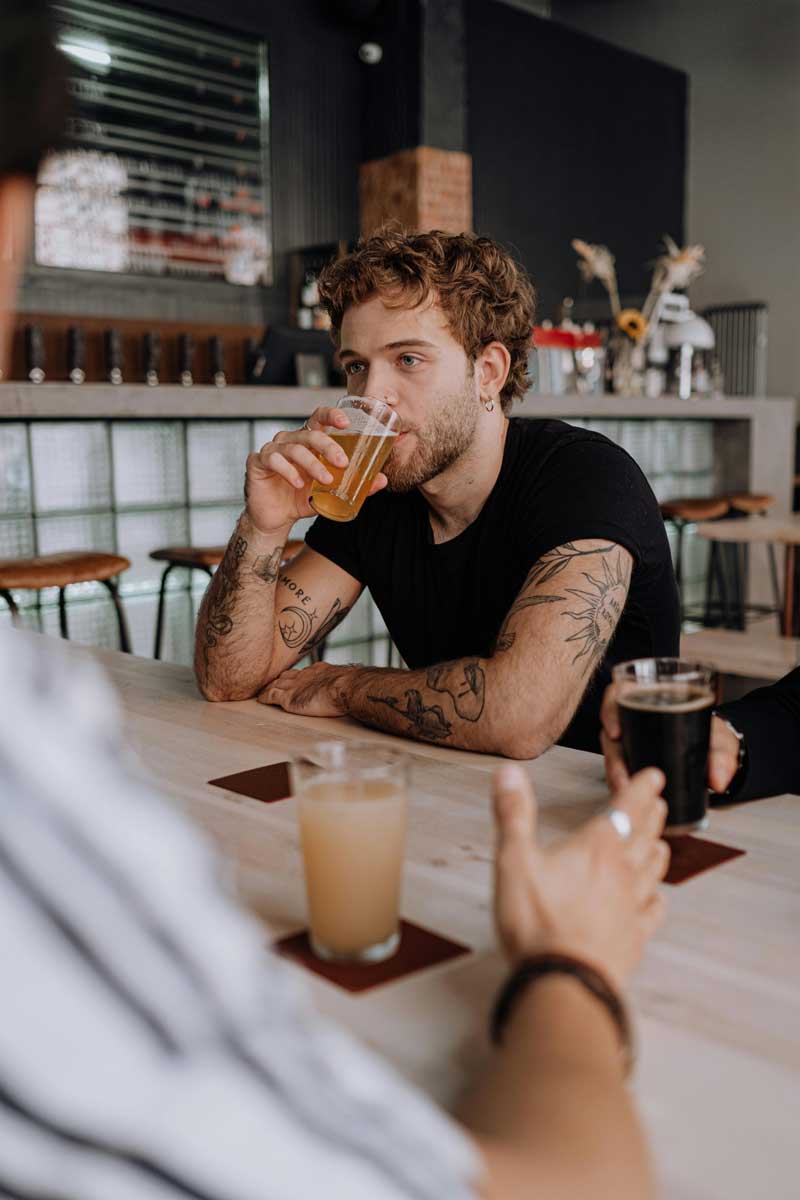
And the source of the photo sparks joy: it’s Alchemy Street Brewing. Eureka! An actual connection to a New Zealand brewery! I’ve struck gold!

But have I? Straight off the bat there’s a few issues. First of all, there’s no mention of anyone called Ross on the Alchemy Street About page. They’re brewed/run by Ed Bolstad. There isn’t any mention of a Ross on their Facebook page. Nor does that particular photograph appear on their social media. Finally, after looking a pictures on their Instagram, I noticed that photo doesn’t even appear to be taken in Alchemy Street’s taproom. Is it of someone involved in the business or a stock photo?

I went back to Google Images and ran the uncropped image through a search again. I confirmed what I’d feared: it’s a stock photo, versions of which you can find all over the web. A dead end again.

Am I being too clever? Too laser-focused? What if I cast the net wide? I mean, really wide? Like, just Google searching “Ross Walton” wide? So I did. And I found something… else.

It’s a website: rosswalton.com. Although to call it a website might be a bit grand. It’s more like the idea of a website – a simulacrum.

Outwardly it looks like a blog, with six posts on it, but weirdly they’re all published on October 4, 2023. They’re just text. No photos, no links. But what struck me most of all was that they are tonally identical to the posts on organicbeer.co.nz. By that I mean there’s a lot of words, but next to no information.

Take this quote for example:

At first that feels like information, until you realise it’s so vague that it’s completely unverifiable. I tried searching for things called the Innovation Award and the Technology Pioneer Award. I found multiple different awards with those names, none of which seem to have been won by a Ross Walton.

Something else has caught my eye:

AI. Yeah, that figures. If this site and organicbeer.co.nz were written by the same AI, that would explain why they have the same weird, alien tone. But then what’s the point of all this? Is this all just someone messing around with AI tools? How does online gambling fit into that? I was pondering this when something else occurred to me: Internet scrubbing.

If you’ve never heard of it, a simple summary would be someone attempting to remove as much of their online presence as possible – things like deleting your social media accounts and requesting removal of yourself from online public records. But there’s another technique to, if at least not remove, then hide something someone don’t want known about them that can be found online. A technique that we might call “flooding the zone”.

Say someone has been convicted of minor fraud, and there’s an article on a news site about it. Next time they apply for a job, if the employer searches their name and finds that article, then there’s no way they’re getting the job. You can’t delete those articles, but what you can do is push them so far down the Google search results that no one ever sees them. The way to do that is by publishing inane, vaguely positive ‘articles’ about yourself, or with your name in them that populate search result ahead of the negative press. Articles that look very much like these ones.

I went digging to see if I could find any evidence of criminality by Mr. Walton. And I mean deep. 20 pages of search results turned up nothing. So I went to news sites – Stuff, Newsroom, RNZ, NewstalkZB. Still nothing. Further afield – The Guardian (AUS), The Guardian (UK), and so on. Nothing. Which isn’t to say I didn’t find evidence of various Ross Waltons committing various malfeasances but nothing I could link to the two websites though New Zealand, beer, brewing, tech, AI, cybersecurity.

I’m really running out of options now. But I’m still looking at website’s URL and I get thinking: I was pretty sure oragnicbeer.co.nz used to belong to the Mike’s Brewery. There’s a way I can prove that, using The Way Back Machine.

The Wayback Machine, also known as the Internet Archive, is essentially a website that archives other websites. It takes periodic snapshots of any given site to that you can look up at a later date. If I wanted to see what content was hosted on organicbeer.co.nz in say 2012, I can go and view a snapshot of that website in that time period.

So I did. And I was correct. There are captures of that website going back to 2004. The most recent ones, December 2023 to March 2025, show the website as it currently exists. But if you jump back in time to the mid-2010s and visited that URL, you would be redirected to the Mikes Brewery website (a separate URL, mikesbeer.co.nz). I actually kind of recommend it as a fun way to view the evolution of their website over time. The earliest captures, show you what it looked like when they still went by the name White Cliffs Brewery.

Captures of the Mike’s Brewery website (the real one) are found from 2004 to early 2018, and then they stop. This would be the point that Mike’s Brewery gave up ownership of the domain. This is when I noticed something else – a series of isolated captures from July 2020 to March 2022. When I viewed them, I discovered something that I was not prepared for. Something that absolutely blew my mind.

There’s another whole version of this website. With a different aesthetic and different articles:

It even a logo:

When I saw it had a logo, I wondered where they’d got it from. What I haven’t mentioned thus far is that most of the photos that illustrate this website have clearly been scraped from the internet. I assumed this had been stolen from somewhere. But I did a reverse image search, this one turned up no results. It doesn’t exist anywhere else on line. This thing is bespoke.

Looking at it, it’s not obviously made by one of those online logo generators. Nor does it have any of the most obvious signs of AI generation – typeface inconsistencies or melting letters. But also I’m not saying it’s not AI generated. It is ugly enough to be.

While a whole new website opens new possibilities – there are six new articles to read. But what I quickly learn is, while they are completely different, they are more of the same slop as we’ve already seen. Take the article “The Best Craft Breweries here in New Zealand”. Here’s the opening sentences:

That feels like AI to me: *Beep-boop* I am not a computer, *WHRRRRR*. I was reading a piece called “The Incredible Evolution of Beer” when something jumped out at me:

There it is: online gambling. And this time it’s not a subtle link, slipped in. This time it’s “Beer is like gambling. People like gambling. Gamble here.” What the fuck? Combing through the other articles, I found multiple references to online gambling. The most egregious being from “Put Down the Beer for Now. Do This Instead”. You know what advice it gives for a safe and healthy alternative to drinking? That’s right, gambling!

Is your highly addictive and detrimental hobby getting you down? Why not try a different highly addictive, detrimental hobby? Enjoy responsibly!

At this point I’m fairly certain that this is a grift and online gaming is the point of it. But at the same time, building multiple fake beer websites for the purpose of funnelling what can only amount to a handful of people to gambling websites just feels too, baroque.

I’m still pondering the URL. It has to be important somehow. Finally, something occurs to me: it’s a .nz. There’s an online function called a whois search. Essentially, you can enter a web address into a whois page and find out who has registered the domain.

Usually this will only tell you which domain company a website is registered with. I had done it with rosswalton.com, and gotten nothing useful back. But .nz domains are a bit different. There’s a database kept by the New Zealand Domain Name Commission of all websites that end with .nz, which contains more information than other online whois databases. And it’s searchable at at dnc.org.nz.

I plugged organicbeer.co.nz into the search box and immediately I had two new pieces of information: a name, and a company.

Which I will not share with you. The reason for this is pretty simple. I’m 99% sure that for the first time in this post, I’m actually talking about a real person. Which is to say I think Ross Walton is fake, but this guy and his company are definitely real. On the one hand, everything I’m writing here is publicly available information. Nor am I accusing anyone of anything illegal or even particularly unethical. On the other hand, I don’t want to bring any kind of heat on this guy, or invite it into my life. If you really want to know those details, they’re there for the finding.

So this outfit is an SEO company out of Ukraine. SEO stands for Search Engine Optimisation. To put it simply, SEO covers ways in which website owners attempt to push their website to the top of search engine results, thereby getting more people to visit their site. It’s one of those incredibly important but also very boring things that has massively shaped the way the internet works.

For the first time ever, I feel like I’ve hit bedrock. This has to be the answer. I just have to make the final connections. I spent a lot of time tracing the online footprint of this guy and his company. But I couldn’t track it back to beer or New Zealand. Eventually though, I found it on what I would describe as a slightly skeezy-looking Vietnamese tech website. I found an article that mentioned both him and his company extensively. It was Vietnamese but as soon as I had translated it, I knew I’d found the answer. The Rosetta Stone that made everything else fall into place:
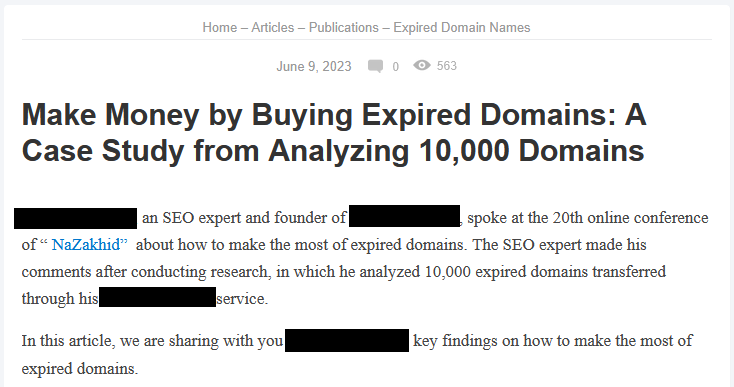
Details are censored, obviously.

Bingo. Cracked it.

This piece is essentially a report on a presentation this person made to a tech conference, laying out how this company makes money from expired web domains. The translation was a little patchy, but the gist of it is summarised here:

Basically what they do is buy old website addresses for cheap and fill them with content. That content drives views, thereby increasing the value of that web domain to companies that want to sell you something. That domain can then be on-sold to said companies at a higher price.

That’s what’s happened to organicbeer.co.nz. Mike’s Brewery dropped the domain back in 2018, and it was re-registered by this company in 2020. I even spotted this little nugget of info that more or less confirmed my deepest suspicion:

I’m pretty sure that’s why organicbeer.co.nz feels like AI slop: because it is.

Mystery solved. Unwittingly, I’ve probably added a few cents worth of value to the domain name with the several hundred clicks I made researching this article. You can see now why I haven’t linked directly to the website. And I’ll say to you now: don’t go there either. There’s no point.

I still haven’t figured out how exactly online gambling fits into this. My best guess is that it’s some sort of affiliate marketing program. If you click on that link, that referral is recorded. If you then go on to make a purchase on that website, the original website gets a cut for that referral. Across 10,000 websites, it might be a viable revenue stream. I am however, speculating here.

I’ve been writing all this up for a couple of weeks, and looking back I feel a little deflated. I’m happy I figured it out, but mysteries are almost always more exciting than answers. I’m left with a question: why did I get so obsessed with this that I sent literally hours searching for the answer?

Partly it’s because I can’t resist the chase. Like a foxhound, once I had the scent I just had to keep going until I’d run it to ground. But there’s something else that’s been bothering me that took me a while to figure out.

I’m a certain vintage of ‘craft’ beer person. I came up in the late 2000s, and back then ‘craft’ beer was these folks we knew: we were mostly all friends, or at least friendly collaborators. We drank in each other’s bars, visited each other’s breweries and attended each other’s events.

Someone and unfortunately I don’t remember who, once described the era as being like the early days of Britpop: going down to Marchfest from Wellington was like Blur going from Sheffield to Manchester to see an Oaisis gig. You knew you’d run into the Gallaghers at the Sprig and Fern afterwards.

That started changing as the industry grew and matured. Frankly it needed to and that was partly why I started this blog. Even though I’m not behind the bar anymore, I do still have something of a fraternal relationship with the ‘craft’ beer industry. People like Søren Eriksen from 8 Wired are still friends, who I’m always happy to see.

So when I see their names and businesses being used by something that seems like a scam, I don’t like it. Now it turns out that’s not really the case. As I said, there’s nothing illegal happening here. I also don’t think anyone has or will be harmed by this website, except maybe a couple of tourists left wandering around Auckland, looking for breweries that don’t exist. But it still just doesn’t sit right with me.

Rather than end on a down note, here’s something a little cheerful: proof that AI still has not and may never supplant human beings. It’s my favourite AI-oopsie from this whole experience:

Armpit. Bowling.

You’ll have to try harder that, GPT.
The Craft Beer Graveyard

Have you ever stopped to wonder how many ‘craft’ breweries we have in this country now? The ANZ report from 2014 lists some 97 breweries/brewing companies of one sort or another. That’s pretty damn high, well done New Zealand! At the same time I first read that list, two things occurred to me.

First: there are breweries missing. I could think of at least two breweries that should be on that list. Second: there are breweries on this list that shouldn’t be there. At least three were known to be out of business at the time of publication. And that really got me thinking: How many breweries have gone out of business in this country? I could think of about five off the top of my head. How many more were there? Ten? Fifteen?

I brought this question up with some Beer Geek friends at the pub, and we started making a list. Twenty breweries in, I realised this was a bigger job than I’d bargained for. So I started digging.

The most complete list of New Zealand Breweries I could find, both current and defunct, is on RateBeer. But even this is missing some that I know have gone under. So I did some more digging, and I made a list of my own.

I’ve compiled every single ‘craft’ brewery I could find, paying attention to the ‘who’, the ‘where’ and the ‘when’. This is possibly the most comprehensive list of defunct breweries in the country. In saying that, there may be errors. I’m not a journalist, I don’t do this sort of thing for a living. I’ve also put some limitations on what counts as ‘craft’ (a few exceptions are made for certain reasons):

  • 1) They are independently owned. Lion, DB and Independent are forever creating and dissolving new ‘brands’, most of which are of little interest to ‘craft’ drinkers. So for example I haven’t included The Temperance or Estadio, which were the predecessors to Black Dog here. Conversely, I probably would make an exception if Black Dog were to close, and put them on the list, because they are of interest to the ‘craft’ crowd at large.
  • 2) I’m only including breweries that have shut down since 2009. This may seem a bit arbitrary, but I have done so for good reasons. Firstly, if I went back much further this list would be impossibly long. If I went back to the 50’s and 60’s, when Lion and DB were shutting down their competitors left, right, and centre, this list would be massive!
    Secondly, I put 2009 as the year the ‘Craft Beer Revolution’ started in New Zealand. Personally, I don’t like to think of it that way. Rather I think of 2009 as ‘The Year The Game Changed’. I have several reasons for thinking this, maybe I’ll write a post about it one day…
    Again, there are some exceptions to this rule, e.g. Historical significance. So Bean Rock Brewing will not be found here, but Limburg Brewing is (see below).

Finally: Caveat Lector. I’m suspect I’m digging into some unpleasant, even painful memories with this post. I’m not doing this to gloat; I’m interested for posterity. Don’t shoot the historian.

Alright, let’s do this.

The ‘Craft’ Beer Graveyard

666 Brewing

Type: Contractor
Formed by Graeme Mahy. 666 was always the brewery without a brewery. Mahy was the original brewer at Moa, before working at Murray’s Brewing in Australia. After that, he knocked around New Zealand trying to find a location to set up shop. A couple of years was spent contracting and collaborating and generally making good beers. 666 was shut down last year when Mahy decided to return to his old post at Murray’s.

Last seen in the wild: kegs are still out there but will be in in rapid decline over the next few months.

Ad Lib Brewing Co.

Type: Contractor
Ad Lib Brewing was Fraser Kennedy and Hayden Smythe. To my knowledge they produced three beers under the label.

Last seen in the wild: Went out of business 2012, Isolated bottles appearing as late as 2014.

Ale Brewing Chaps

Type: Contractor
The Ale Brewing Chaps was an initiative of five people: Ben Middlemiss, Vrnda Duncan, Alan Knight, Jerry Wayne and Rob Hillebrand. The idea was to brew beers for festivals. The brewery they used still exists on Waiheke Island, operated by Wayne under the name Relativity Brewing.

Last seen in the wild: December 2014.

Anchor Brewing

Type: Brewery
I’ve only included this brewery because it exists as a weird listing on Beer Tourist. No reliable online information could be found. Asking a few of my friends that have been in the industry longer than I have, I discovered that they were based in Porirua in the 80’s-90’s, not in Hunterville, as Beer Tourist suggests.

Arrow Brewing

Type: Brewpub
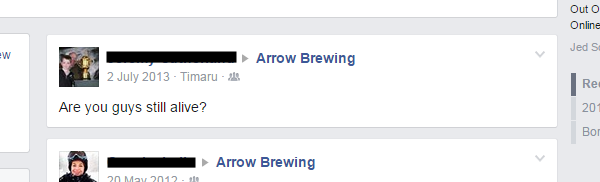
Based in Arrowtown, started in 2008. Seems to have gone out of business some time in 2013.

Last seen in the wild: Bottles still surfacing as late as January this year. Tap seems to have dried up in 2013.

Nope.

Nope.

Beltane Brewing

Type: Contractor
Formed by Vicki-Marie Yarker. They produced a wheat beer that I remember pouring at Hashigo. A rampant infection turned the beer into foamy acid in the kegs. They also produced a ‘snakebite’ cider.

Last seen in the wild: September 2012

CORRECTION: despite a hiatus of somewhere between 3-5 years, it seems that Beltane has not ceased to exist. I’ve been informed that they currently have a new beer aging in port cask. 

I greatly look forward to it’s release. 

FURTHER CORRECTION: I have since learned that there were in fact two batches of Wheat Beer produced by Beltaine. Only the second one showed signs of infection.

Bear Empire

Type: Contractor
Details are elusive, but seems to have started in 2012 and been the enterprise of one Wade Kirk. They made a ‘Black IPA’ and a ‘Red Pilsner’ (?!). Their logo looked a hell of a lot like the Bear Pride Flag.

Last seen in the wild: Check-ins of the Saboteur Red Pilsner from 2015 cannot be trusted, as at least one has a picture of the wrong beer. Last reliable check-in is from November 2013.

Brewery Britomart

Type: Brewpub
Started circa 2011 by Lawrence Van Dam and John Morawski (who now has a contract brewery called ‘Laughing Bones’). They made a Dubbel and a Belgian IPA that were mysteriously similar in ABV and colour, which I always suspected of being the same beer with different hops. Britomart went out of business in early 2013.

Last seen in the wild: Strangely it seems that a few kegs have surfaced recently and have gone on tap at Vultures Lane.

CROOKED CIDER/CROOKED ALES/50 KNOTS BREWERY

Type: Cidery/Brewery
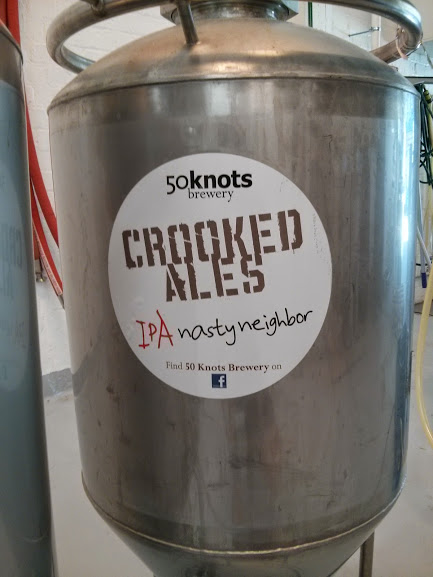
I’ve written a little on the history of Crooked here. Technically they’re still producing cider, but they make the list because it really only still exists in name. The original orchards and brewery equipment is gone and the current product bears little resemblance to the original.

Last seen in the wild: Still in production.

An old piece of %0 Knot's equipment recently spotted at another brewery.

An old piece of 50 Knots’ equipment recently spotted at another brewery.

Geek Brewing

Type: Contractor
Started in 2012, Geek was the product of Andrew Cherry. They made one very nice Coconut Porter before disappearing.

Last seen in the wild: Isolated bottle appeared December 14.

Green Man

Type: Brewery
Based in Dunedin, Green Man was the brewery that kicked off the whole ‘Radler’ debacle – a textbook case of the mega brewers trying to muscle the small guys. I fondly remember voting in favour of the SOBA initiative to go to bat for Green Man in the IP court at the AGM, circa 2009; a memory I look back on with irony, as I always disliked the brewery.

There's a lot of history in this one image.

There’s a lot of history in this one image.

Frankly, their beers were at best pedestrian; at worst a parade of infections and brew faults. We all knew that Green Man wasn’t going to last in a market with consumers increasingly demanding quality. Having said that, they did circle the drain for about two years longer than I thought they would.

Last seen in the wild: Still available in many places.

Golden Ticket

Type: Contractor
Launched by Nathan Crabbe and Ally McGilvary in 2009, and went out of business some time around 2012. Nathan left to take up a job at Harrington’s, then set up Resolute Brewing (see below). Their beers were pretty good, except ‘Summer Babe,’ which I remember smelling like vomit Parmesan.

Untitled

A very dormant Phoenix…

Last seen in the wild: Some seems to have cropped up in California last year (?). Otherwise, last seen in this country November 2013.

Hophugger

Type: Contractor
Hophugger was a subsidiary of Timaru based company Treehugger Organics, and appeared around the summer of 2012/13. They were one of the first beers I ever reviewed (back when I still did that).

Last seen in the wild: October 2014.

Hopmonger

Type: Contractor
Formed by Edward Valenta in 2013, at that time working behind the bar at Pomeroy’s and as Assistant Brewer at Twisted Hop in Christchurch . Ed formed the company to get a bit of brewing and business experience before moving back home to the States.

Last seen in the wild: September 2014.

Hops Valley

Type: Microbrewery
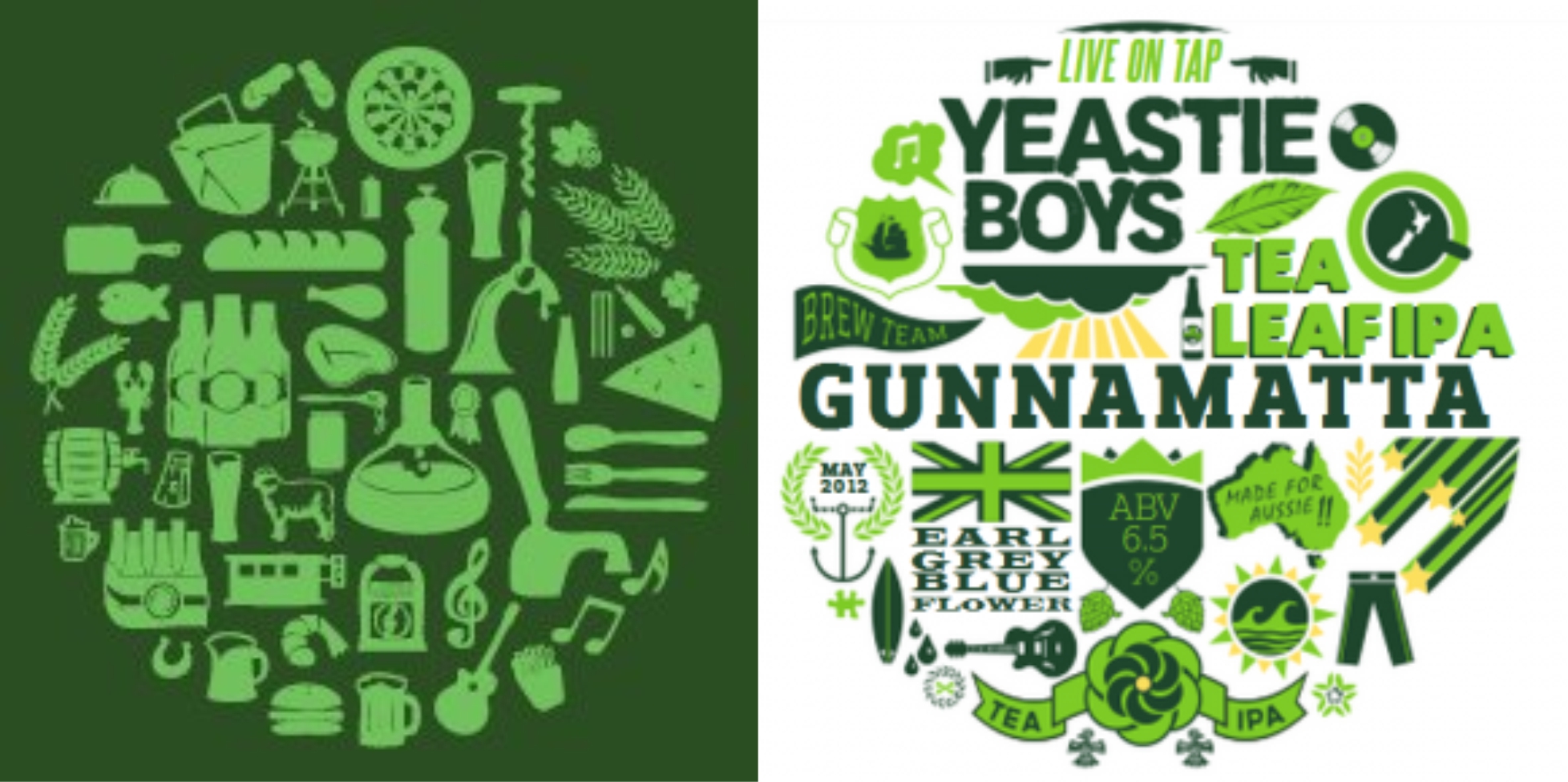
Started by Tony McDonald and Cory Watts in 2012. I will always remember Hops Valley as the brewery that had an IP dispute with Yeastie Boys over the original Gunnamatta label.

Frankly I think Yeastie Boys made a good call not using this logo.

Frankly I think Yeastie Boys made a good call not using this logo.

Last I heard of them, they were attempting to sell their company on Trademe for way too much money (considering it consisted of a Farrah homebrew kit and a logo). They did eventually find a buyer, who has yet to surface.

Last seen in the wild: August 2014.

Island Bay Brewing Company (AKA Bennett’s)

Type: Contractor
Bennett’s Beer is the stuff of legend amongst the old guard of the Wellington beer scene. Maurice Bennett set up the company in 2006. Instead of the popular method of contracting we see today – sending a recipe to a brewery and having them make your beer for you, Bennett just bought beers off other breweries and stuck his label on them [EDIT: with the breweries knowledge and consent. He may also have had some original recipes, it’s not entirely clear]. They were Harrington’s and Tuatara’s beers specifically, but I’ve heard stories of Bennett running out of beer mid-festival and attempting to buy kegs off other stands to wheel over to his stand and sell.

Bennett’s shut up shop some time around 2010, but the legacy lives on, in other contract breweries that are more about having a beer with your name on it than quality and passion for the product.

Last seen in the wild: Two isolated Untappds from the last two years. Ratebeer puts it at 2010.

Kakariki Beer Co.

Type: Contractor
Started in 2013 by Simon Crook, an ex-LBQ bartender. This was a single-beer entity: Goldilocks Blonde Ale.

11084238_776197679143193_2632479218104073296_n

Last seen in the wild: October 2013.

Kiwi Brewery

Type: Brewery
The only reference I can find online to Kiwi Breweries is that it was in Morrinsville, and that its equipment was sold to Croucher Brewery. However, the Companies Office reveals that the directors were Gary and Valerie Hallett, that the company was registered in 2003, and last filed in 2010.

Last seen in the wild: No idea.

Limburg

Type: Brewery
Limburg is an often forgotten piece of brewing history. People with long memories rave to me about Limburg Hopsmacker, possibly the first modern APA brewed in New Zealand (although that may be Emerson’s APA). The company was the efforts of Craig Cooper and Chris O’Leary. It operated from 1998-2006.

Admittedly, this is outside my range here, but they are included here because of their historical significance: After the close, O’Leary went to become Brewery Manager at Emerson’s and Cooper went to work in Australia and Canada before founding Bach Brewing.

Last seen in the wild: Funnily enough, I have the last reliable check in of a Limburg beer – September 2013, a bottle of Oude Reserve 2004 from Dom Kelly’s cellar. More recent check ins are harder to verify and may be Bach Brewing beers with the same name.

Matson’s

Type: Brewery
Matson’s was a Christchurch-based brewery that never really made (or attempted to make) inroads into the ‘craft’ beer scene. In many ways, they were more like a macro brewery: all but one of their beers were 5% or lower, most (if not all) of their beers were lagers and several of them were actually made by blending two beers together.

The only beer of theirs I ever poured at Hashigo was the surprisingly good Pine tree Black, a beer by then-brewer Colin Garland.

Matson’s went into liquidation and was bought by Harrington’s, their brand dissolved, and their considerable capacity absorbed into Harrington’s.

Last seen in the wild: still plentiful in bottles, but will become rarer over time.

Monkey Wizard

Type: Brewery
Built by Matt Elmhirst in Motueka. Monkey Wizard was sold and taken over by Simon Nicholls to become Hop Federation.

Last seen in the wild: November 2013.

MUBS (Massey University Brewing Society) AKA Half Tanked Brewing

Type: Contractor
This is an odd one. This is the ‘Commercial Brewing Arm’ of the Massey University Brewing Society (ostensibly a homebrew club). It was lead by Simon Crook, who later went on to start Kakariki Beer Co. (see above) and like Kakariki, was a single batch entity: ‘1’ Pale Ale. Presumably it was meant to be followed by a beer called ‘2’, or maybe the name was meant to be prophetic.

Last seen in the wild: December 2012.

Yes, beer is made in tanks, that's a very clever pun. But could you have chosen slightly less punchable face to market it with?

Yes, beer is made in tanks, that’s a very clever pun. But could you have chosen slightly less punchable face to market it with?

Naturale

Type: Contractor.
Brewed out of Roosters in Napier. I feel like I’ve wailed on Naturale a bit too much this year, so I’ll keep it brief. Started circa 2011 by Tony Dapson. Went out of business the same year. Currently trying to rebuild on Indiogogo for the sixth time.

Last seen in the wild: November 2011.

Pink Elephant

Type: Brewery, now a contractor
Pink Elephant was founded by Roger Pink in Nelson, circa 1990. Pink Elephant is an odd one, insofar as it’s a brewery that’s done the reverse of what most breweries do these days. It’s gone from being a actual brewery, built of steel and concrete, which has been shut down in favour of becoming a contract brewer.

And I guess that’s why they make this list, because the ‘brewery’ that was Pink Elephant no longer exists, even if the ‘brewing company’ does.

Last seen in the wild: Still out there.

Rascal’s Brewing

Type: Contractor
Started 2013 by Vance and Wendy Kerslake. This was another single beer entity. Unusually their first and only beer was an Oktoberfest (amber lager).

Last seen in the wild: July 2014.

Resolute Brewing

Type: Contractor
Formed by Nathan Crabbe (see Golden ticket). After Resolute he went off to brew for Four Avenues. 

Last seen in the wild: Whilst bottles of cider kept appearing as late as 2014, the records indicate it was last on tap in October 2013.

Revolution Brewing

Type: Contractor
Formed by Brendon Mckenzie, circa 2010. A single batch of beer produced – ‘ANTIFA Amber Ale’.

Last seen in the wild: There are literally no records of this beer online.

Rogue Brewery

Type: ?
This is another strange listing on Beer Tourist. I have no idea where or when Rogue Brewery actually existed. There’s no record of them in Ratebeer or Untappd. There is a registered company under the name at the Companies Office, but nothing else can be found easily.

Secret Seven

Type: Contractor
I’d consider the Secret Seven a failed experiment. This was a single-batch contract brewery which came with a manifesto stating that beer should be about quality and not personality. I agree with many of the points they raised. I dislike the culture of star-struck fanboys that crops up from time to time in this industry (worst example: Garage Project’s 24/24). And I actively despise brewers who want to wrap themselves in the cult of personality, because the brewing industry in New Zealand is no place for wannabe rockstars.

I think though, that Secret Seven missed an important point: yes, ‘craft’ beer has been built on quality, but it’s also been built on stories. People love to connect to the Who, the Where and the Why of the beer they drink. Frankly the story of ‘some Schmos made some beer’ I find neither compelling nor particularly original.

And for that matter, who do they think in the ‘craft’ beer sector is using bikini models, I wonder? Actually Island Bay Brewing (see above) pretty much did this…

Last seen in the wild: Their Amber Ale ‘S1’ (Like MUBS I assume the plan was to make S2, S3, etc.) was last Untappd December 2013.

Shitwhistle Brewing

Type: Microbrewery
I’m not even going to bother looking into this one. Apparently it’s a legit surname, but whatever. Here’s their FB ‘About’ section:

Please do not to slap the next Dave you meet after reading this.

Please do not to slap the next Dave you meet after reading this. Also: 1895? Pull the other one.

Last seen in the wild: The brewery doesn’t exist according to Untappd. There is only one lonely Ratebeer entry from from our friend Jono, dated June 2013.

Southstar Brewing

Type: Contractor
Formed in 2012, this was Kiearan Haslett-Moore’s contract label, mostly for collaboration purposes. He’s since gone on to set up North End Brewing, and so Southstar has faded away.

Last seen in the wild: July 2014.

Stewart Brewing

Type: Contractor
Not from Stewart Island but named after the brewer, Tim Stewart. Founded in 2013. Made some really nice beers. Info on this one supplied by Jules Van Cruysen of XY Eats and Kiwi Craft.

Last seen in the wild: April 2015.

The Little Empire

Type: Brewpub
Strictly speaking this was Lion Nathan, so shouldn’t be on my list, but I included them from interest sake – because The Little Empire was the label of The Crown Brewpub; which was the name of the bar that took over The Brewery Britomart. I’m presuming they’re extinct because of this post on Facebook:

Crown

It’s unclear what’s moved into the premises, but with no check ins or updates on Untappd, we can assume the label is no longer current.

Last seen in the wild: October 2014.

Cider House Orchard (Three Rivers)

Type: Cidery
Another one I wouldn’t believe existed, if I hadn’t had their cider. I maintain they were well ahead of their time. After it’s sale, Cider House became Crooked Cider (see above).

Last seen in the wild: Ratebeer puts their end at December 2008, but I know I was drinking them regularly at Hashigo in early 2010.

Two Fingers Beers

Type: Contractor
Started in 2012 by Lawrence Oldershaw, Two Fingers is the most recent brewery to make this list, closing in February 2015.

Also spotted at another brewery.

Also spotted at another brewery.

Last seen in the wild: Still plentiful, but will gradually die out.

Velvet Worm

Type: Microbrewery
Velvet Worm is an odd one. They appeared in 2012 in Dunedin, started by a chap called Bart Acres and fell off the radar in 2014. I had them on the first draft of this list (their Facebook page was gone and their beers began to drop off on untappd), but took them off when I discovered that a company still existed under the name Stacpoole’s Brewing Co. and listing John Barton Stacpoole Acres as a Director. So I assumed that there is a direct continuity between the two, and possibly even a continuation of the Velvet Worm brand.

I was tipped off again by Jules Van Cruysen that Velvet Worm is no longer an active band. A complete rebrand of a brewery is fairly drastic an action, and probably justifies the old label making this list.

Last seen in the wild: April 2015.

Waituna Brewing

Type: Contractor
Waituna made the ‘Taakawa Indigenous Ale,’ a Golden Ale spiced with Kawakawa. Waituna never really appeared on the ‘Craft’ beer map (I don’t think I ever tried it). Started circa 2002, went out of business 2011.

Last seen in the wild: One check in from December 2014, the previous ones from 2011.

West Coast Brewery

Type: Brewery
I umm-ed and ahh-ed over whether to include West Coast Brewery on this list, as there is still an entity that has been operating more or less continuously under the same name and in the same location. I included it though because West Coast was put into liquidation in 2012. Here’s the story:

West Coast was started in 2007 by Paddy Sweeney, a self-styled West Coast Larrikin, a claim I’ve always found puzzling, since he lives on the East Coast. Of Australia.

Anywho, the story of West Coast Brewing is the story of a bluffo-Kiwi-Bloke vs. bureaucracy and red-tape. At least that’s the book version, anyway. No really, he wrote a book about it.

Apparently the red tape Sweeney was rebelling against was paying those pointless taxes the government keeps banging on about, because West Coast ended up massively in the hole to the IRD.

The future of the company is unclear at this stage, but several moves to buy it back have been made by the original owners. Ultimately I include West Coast here because it’s been run pretty hard into the ground, and only really exists because of the strange vagarities of New Zealand Companies Law.

Last seen in the wild: Still brewing, may very well pull through.

Wests

Type: Contractor
Wests is a ‘beverage company’ (soft-drinks manufacturer) claiming to have been around since 1876. They’re still operational, but make this list because in 2004 they released a ‘Wests Ale’. I know this is a little before my remit, but I’ve included Wests because it’s fascinating example of a company outside the industry dabbling in beer.

Last seen in the wild: January 2004.

Yellow Cross

Type: Brewpub
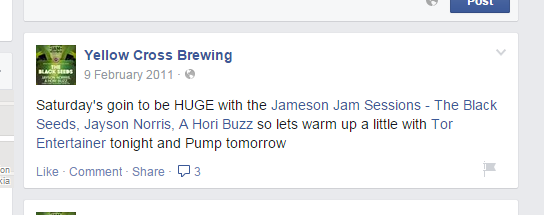
Yellow Cross, a brewery I admit I’ve never heard of, and stumbled across by accident. It seems like rather a tragic story: The only record of them is a Facebook page (no Ratebeer or Untappd). The page reveals their location used to be in Christchurch on Lichfield Street, between Poplar and Madras Streets. The page was updated regularly until February 2011. Many readers will be able to connect the dots here. Two weeks after the last posting, a massive earthquake totalled that entire section of the city.

Yellow Cross

Many breweries were damaged in the Christchurch earthquakes, but no other breweries to my knowledge were completely put out of business.

Last seen in the wild: February 2011, I guess.

UPDATE: An ex-Cantabrian has informed me that Yellow Cross was a meat-market club. Others have have informed me that it was a DB-subsidiary.

Post Mortem

So how many breweries is that? For those who haven’t been counting or just skimmed the list (I don’t blame you), it’s thirty nine. That’s thirty nine ‘craft’ breweries (broadly speaking) that have gone out of business during the course of the ‘Craft Beer Revolution’ (broadly speaking).

That’s a hell of a lot. It’s more than anyone I spoke to predicted; most people guessing about half that number. And I know that I’ve missed breweries off this list. There will be breweries out there that appeared and disappeared without leaving a trace, and even brewing companies that never even made any beer before they shut down. Likewise, although no one wants to admit it, there are small breweries out there that are currently circling the drain, and will go down in the next year or two. Conversely, there may be breweries that will rise, phoenix-like again. But I’m sure this list is at best, a low-ball estimate.

But what can we take away from this list?

When I started researching, I thought I would find one or two common reasons why breweries close. In reality there are many reasons, many of which could apply to both stainless and contract breweries: buyouts, poor business management, unsustainable business models, changes in life situations, falling-outs between partners, moving on to other project and so on. I didn’t find any single cause of brewery closure.

What I did find though, is that there’s noticeably more contractors (22) than steel-and-concrete breweries (17). This is not entirely surprising, considering the sizeable commitment of setting up a brewing-plant, compared to the relatively minor paper-shuffling it takes to start a contract company. With more skin in the game, physical breweries tend to stick around longer.

What’s more interesting, is the relative ages of the different types of breweries: the majority of stainless breweries that have closed in the last six years opened before 2009; before the start of the ‘Craft Beer Revolution’. Conversely, most of the of the contract breweries opened after 2009.

If I can wildly speculate and generalise for a moment, I’d like to posit two ideas.

First: the older stainless-steel breweries are more likely to close down because they have not been able to keep up with changes in the market place. Examples of this I think are Matson’s and Green Man. Both had been around for quite some time and been fairly successful in their day, but neither of them made particularly good beer or much of a splash in any other regard. When the market changed and consumers of ‘micro-brewed’ beer (to borrow an Americanism) began demanding more quality and innovation, their markets began to dry up.

To put it bluntly, those breweries that fell behind, were left behind.

Now my second point: the majority of contractors that have shut down, were started after 2009 and seem to have been short-lived. We see multiple companies that produced one or two beers, or even just one or two batches of beer before closing. That’s indicative I think, of the type of light-weight business model that contract brewing employs; and I don’t think that’s necessarily a bad thing.

But…

I think the time is also coming where we in the New Zealand brewing industry need to have a discussion about contract brewing. That discussion is too big to fit into this post. Maybe I’ll write about it soon. But I’ll offer up one suggestion here: starting a contract brewery is a hell of a lot easier than actually running a successful brewing business. A lot of people that get into the brewing game are not adequately prepared for the realities of the industry; and with relatively little at stake, they don’t last very long.

But whatever. This is all speculation. For now, I hope you’ve enjoyed this stroll down brewing memory lane. Or at least found it interesting.