I Found… Something?

Have you ever been doing an absolutely mundane task and suddenly stumbled upon something utterly weird? Like can’t stop thinking about it, can’t look away weird?

Recently I was trying to find the website for Tuatara Brewery. Now that was difficult, because they don’t actually have one, rather they have a page on DB’s website. But searching for Tuatara’s website led me to a completely different place. A weird place. A place that just doesn’t make any god-damn sense. A website called organicbeer.co.nz.

I’m not going to link to that page. At time of print it’s still there, but don’t go visit it for reasons that will become clear. This website struck me because well, almost everything on it was wrong. Not just factually wrong, but weirdly wrong.

Organicbeer.co.nz bills itself as a “travel blog about New Zealand Beer” which is a weird choice of URL for a travel blog. Then there’s the title of the website “Mikes Brewing”. Now if you’re of the same vintage of ‘craft’ beer nerd as me, that means something to you. Mike’s was a brewery in Taranaki, and they did indeed make organic beer. Mike’s went into receivership in 2017, and through a series of changes and restructuring, became a bistro in New Plymouth, which still exists to this day. So why then is this website pretending to be Mike’s Brewery?

And it is definitely pretending to be the Mike’s Brewery. On the website’s menu is a dedicated tab and page profiling Mike’s Brewery, that does reference the brewery’s old location, but doesn’t mention that the brewery has moved and no longer makes beer. This is very strange. I just couldn’t shake the feeling that something was very off but I was also kind of hooked. I wanted to know: What am I looking at here?

At this point, I noticed a page called “NZ’s Top 100 Beers: A Brief Overview”, published October 2, 2023. I decided to give it a read and let me tell you, it’s weird. For starters this is supposed to be a ranking of top beers in NZ but it has a lot of extra guff:
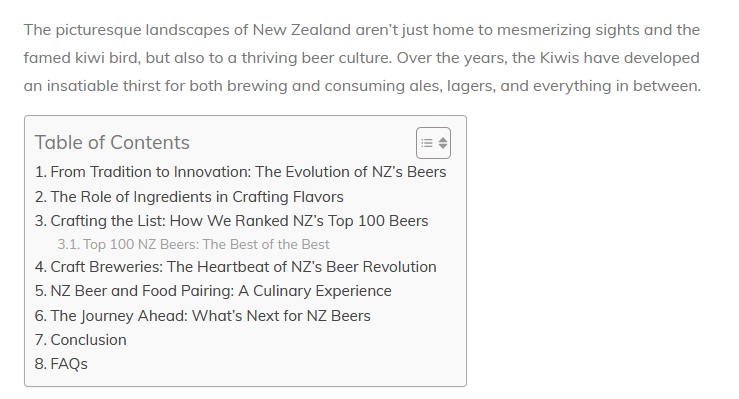
And these extra sections are full of platitudes about beer and brewing that are so generic, they’re almost meaningless:

OK, fine. This person isn’t a great writer. Lets get to the list. It’s organised by beer style, with a desciption and an example of a beer that fits said style. This is a little bit of an odd way to do it, but whatever. Let’s give it a chance. Trouble is, this list is full of things that are simply wrong:

Garage Project Hāpi Daze is not a Saison. This sort of error kept happening as a I scrolled down the list. Does the person who wrote this actually understand anything about beer styles? Many beers were filed under the wrong style category and some beers were listed that I’m sure were no longer in production when this article was written, sometimes from breweries that had closed years previously. I had a realisation: I don’t think this list is written by someone with a poor grasp of beer styles. I don’t think it was written by anyone. I think it’s AI.

I suspect this was created by someone plugging a prompt into ChatGPT (or similar) such as “Write a list of the top 100 beers in New Zealand by style category”. The AI in response has gone to the internet, presumably Untappd and the now defunct RateBeer and scraped a list of top beers in New Zealand, smashing it together with a list of beer styles. Where the two lists don’t match up – styles where there aren’t a lot of beers that fit the category, the AI made connections that don’t make sense.

A great example would be Bière de Garde. I doubt there’s more than half a dozen examples of the style in New Zealand, and probably none of them are ‘core-range beers’. So the AI chooses a beer that might have vaguely similar words in it’s tasting notes. In this case, Choice Bros Reet Petite, a Red IPA.

I started looking for a smoking gun – something that proved this list was wasn’t written by a person: an AI hallucination. It wasn’t long before I found one:

Tiamana Pils Dunkel is not a beer that ever existed. I know because I was indirectly involved with Tiamana. I was there when they opened in 2015 and I was there when they shut in 2018. At no point did they ever make a beer called Pils Dunkel, or even a Dunkel. This is a completely fictitious beer.

With all this in mind, I started reading more and more articles. Pieces with titles like “10 Must-Try Craft Beers in New Zealand”, “Exploring the Strongest Beers in New Zealand” and “What Is The Most Popular Beer In New Zealand”. These are all titles you might plausibly find on a lifestyle or travel blog. But if you actually read them, everything about them is wrong. Not factually wrong. The details are usually broadly accurate, but just somehow the articles are always just off.

For starters, the structure of the articles is weird. Almost every article has a table of contents, whether it’s warranted or not. They also end with a ‘Conclusion’ section and sometimes even an FAQ. It makes it feels more like technical writing, not lifestyle or travel writing.

Take “10 Must-Try Craft Beers in New Zealand”. It starts off with a weird table of breweries and mini bios called “Main Features”, which doesn’t feel right to me. Again, it feels more like part of an abstract or summary from a technical article. After that it goes to detailed bios, which again feel like more empty platitudes, stretched versions of the “Main Features”, with details pulled and re-worded from marketing material.

Garage Project, Epic and 8 Wired are the first three profiles, But for some reason 8 Wired gets a whole extra section, titled “The Spirited Rise of 8 Wired Brewing Co.” which is an almost exact repeat of all the info from the previous paragraphs. And I do mean exact, down to the sentence level. Here is the opening sentence of section one:

8 Wired Brewing Co., a beacon of inspiration for aspiring entrepreneurs and a shining example of Kiwi ingenuity and relentless pursuit of excellence.

And here’s a sentence of section two:

…embodying the essence of Kiwi innovation and tenacity, 8 Wired Brewing Co.’s journey resonates deeply with those harboring dreams of entrepreneurship.

That’s literally the same sentence worded two different ways. This feels like classic AI repeating itself – pulling information form articles and websites, shuffling keywords and subbing synonyms to endlessly recycle the same basic points.

This feeling really stuck with me. It felt like everything was made up of borrowed parts, cobbled together. Like I was looking at Giuseppe Arcimboldo’s painting of Vertumnus. Except instead of a clever collage forming an optical illusion, it’s a weird meaningless mish-mash that, try as you might, you just can’t make sense of.

This feeling peaked with the article “Unravelling Auckland’s Steam Brewing Secrets”. You would assume this is an article about Steam Brewing Co., the Auckland-based production brewery that makes beer under contract for many different breweries around the country, right? Not so.

This piece is about steam in the brewing process, as used by breweries in Auckland.
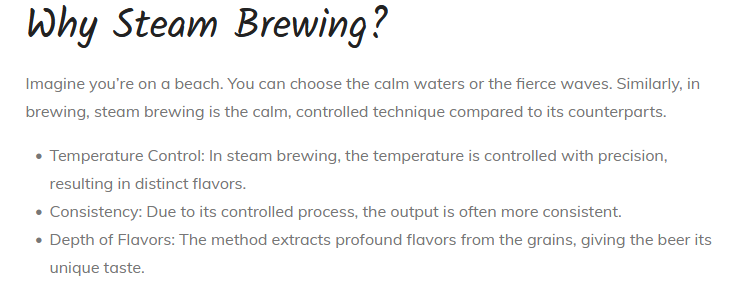
I suspect someone has prompted the software to write about Steam Brewing and confused, it’s spat out several hundred words of nonsense, including recommending visits to three breweries that I’m pretty sure don’t exist:
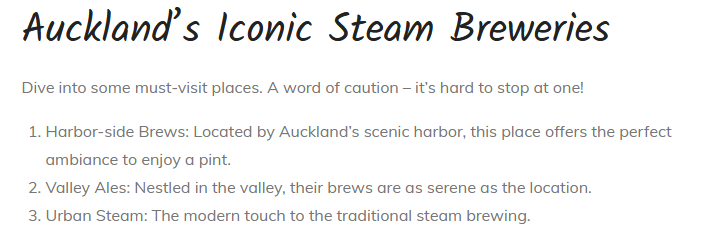
At this point, I think I’ve got the picture. Someone has made a fake blog about beer in New Zealand, probably using AI. Staring at my screen and feeling bamboozled, I’m left with many questions, chief among them: Why? What’s the point of all this? Is it a scam? It certainly feels scammy. But if that’s the case, what’s the actual hustle going on here? I start digging, maybe somewhere in one of these posts is this website’s raison d’etre.

I find myself looking at a list of recently published posts. So far, every article has been about NZ beer, but not the last five:

They’re still broadly beer related, except the second one. American Football? This article, while sort of about NZ it’s only tangentially related to beer. It’s mostly about watching American Football. But something else jumped out at me – there’s a link.

That’s when I realised: thus far, I haven’t seen a single link anywhere else on this website. This feels like a dog that isn’t barking. Surely if this is a scam, the point of the scam would be whatever this website is trying to push me towards, which has so far been nothing.

But now there’s a link. To the New Zealand TAB website. Gambling? Weird.

That’s when I remember the other recent article: The Perfect Pairing: Enjoying a Day at Hastings Races with a Refreshing Beer. There’s a connection there: races – horse racing – gambling. Was this the point? Some sort of asymmetrical marketing campaign for the TAB?

In a word – no. Because this isn’t an article about horse racing in Hastings, New Zealand. It’s about horse racing in Hastings, Vancouver, British Columbia, Canada. How does Canada fit in to all this? There’s another link on this page. But this time it’s a link to an Aussie gambling website justhorseracing.com.au, not the TAB.

On the one hand, I suspect this is AI making nonsense connections, but it also feels like the closest thing I’ve found to a pattern. I searched for a while to see if I could find any more external links but turned up nothing. A dead end.

Stepping back a bit to think about a new line of enquiry. If I can’t figure out the why of this website, maybe I should focus on the who. Each article has something I’ve thus far ignored: a byline. The author of this website is someone called Ross Walton.

There’s an about page too. And just like every other page on this stupid website, it contains a lot of words, but almost no information. As near as I can tell, he is apparently some dude who likes beer and has visited some breweries. That’s it. That’s the only biographical data to be found. But a name is something to go on, and there’s a picture too:

This might be useful. If I can find some other record of this Ross Walton and if I can match another photograph, maybe I can crack this thing.

The trouble is, Ross Walton is a very generic name. Only a few degrees less generic than ‘John Smith’. A simple search is going to reveal scores, maybe hundreds of Ross Waltons. So I try a series of searches.

“Ross Walton + Beer”, “Ross Walton + New Zealand”, and so on point me straight back to organicbeer.co.nz. Even filtering out those results I find multiple records of Ross Waltons, none of which I can positively ID.

Social Media is the same: FB, Insta, that other one, and LinkedIn. Too many results, nothing solid to go on. It doesn’t help that he looks like a generic, late millennial white-boy. That describes a pretty big chunk of the ‘craft’ beer demographic and yes, I’m in a glass house on this one.

I tried to get a bit clever and go the Companies Office. I’ve spent a lot of time tracing breweries and the people who own them through the through the Companies Register. Again, multiple Ross Waltons or variations thereof, but nothing verifiable. It’s the same for IPONZ.

I’m stumped. But I’m also looking at that photo. I had originally planned to see if I could find any other pictures of Walton and match the face in that photo. But what if I matched that exact photo?

I ran a reverse Google Image search and immediately found the original. And I can say it is the original, because the version on organicbeer.co.nz has been cropped:

And the source of the photo sparks joy: it’s Alchemy Street Brewing. Eureka! An actual connection to a New Zealand brewery! I’ve struck gold!

But have I? Straight off the bat there’s a few issues. First of all, there’s no mention of anyone called Ross on the Alchemy Street About page. They’re brewed/run by Ed Bolstad. There isn’t any mention of a Ross on their Facebook page. Nor does that particular photograph appear on their social media. Finally, after looking a pictures on their Instagram, I noticed that photo doesn’t even appear to be taken in Alchemy Street’s taproom. Is it of someone involved in the business or a stock photo?

I went back to Google Images and ran the uncropped image through a search again. I confirmed what I’d feared: it’s a stock photo, versions of which you can find all over the web. A dead end again.

Am I being too clever? Too laser-focused? What if I cast the net wide? I mean, really wide? Like, just Google searching “Ross Walton” wide? So I did. And I found something… else.

It’s a website: rosswalton.com. Although to call it a website might be a bit grand. It’s more like the idea of a website – a simulacrum.

Outwardly it looks like a blog, with six posts on it, but weirdly they’re all published on October 4, 2023. They’re just text. No photos, no links. But what struck me most of all was that they are tonally identical to the posts on organicbeer.co.nz. By that I mean there’s a lot of words, but next to no information.

Take this quote for example:

At first that feels like information, until you realise it’s so vague that it’s completely unverifiable. I tried searching for things called the Innovation Award and the Technology Pioneer Award. I found multiple different awards with those names, none of which seem to have been won by a Ross Walton.

Something else has caught my eye:

AI. Yeah, that figures. If this site and organicbeer.co.nz were written by the same AI, that would explain why they have the same weird, alien tone. But then what’s the point of all this? Is this all just someone messing around with AI tools? How does online gambling fit into that? I was pondering this when something else occurred to me: Internet scrubbing.

If you’ve never heard of it, a simple summary would be someone attempting to remove as much of their online presence as possible – things like deleting your social media accounts and requesting removal of yourself from online public records. But there’s another technique to, if at least not remove, then hide something someone don’t want known about them that can be found online. A technique that we might call “flooding the zone”.

Say someone has been convicted of minor fraud, and there’s an article on a news site about it. Next time they apply for a job, if the employer searches their name and finds that article, then there’s no way they’re getting the job. You can’t delete those articles, but what you can do is push them so far down the Google search results that no one ever sees them. The way to do that is by publishing inane, vaguely positive ‘articles’ about yourself, or with your name in them that populate search result ahead of the negative press. Articles that look very much like these ones.

I went digging to see if I could find any evidence of criminality by Mr. Walton. And I mean deep. 20 pages of search results turned up nothing. So I went to news sites – Stuff, Newsroom, RNZ, NewstalkZB. Still nothing. Further afield – The Guardian (AUS), The Guardian (UK), and so on. Nothing. Which isn’t to say I didn’t find evidence of various Ross Waltons committing various malfeasances but nothing I could link to the two websites though New Zealand, beer, brewing, tech, AI, cybersecurity.

I’m really running out of options now. But I’m still looking at website’s URL and I get thinking: I was pretty sure oragnicbeer.co.nz used to belong to the Mike’s Brewery. There’s a way I can prove that, using The Way Back Machine.

The Wayback Machine, also known as the Internet Archive, is essentially a website that archives other websites. It takes periodic snapshots of any given site to that you can look up at a later date. If I wanted to see what content was hosted on organicbeer.co.nz in say 2012, I can go and view a snapshot of that website in that time period.

So I did. And I was correct. There are captures of that website going back to 2004. The most recent ones, December 2023 to March 2025, show the website as it currently exists. But if you jump back in time to the mid-2010s and visited that URL, you would be redirected to the Mikes Brewery website (a separate URL, mikesbeer.co.nz). I actually kind of recommend it as a fun way to view the evolution of their website over time. The earliest captures, show you what it looked like when they still went by the name White Cliffs Brewery.

Captures of the Mike’s Brewery website (the real one) are found from 2004 to early 2018, and then they stop. This would be the point that Mike’s Brewery gave up ownership of the domain. This is when I noticed something else – a series of isolated captures from July 2020 to March 2022. When I viewed them, I discovered something that I was not prepared for. Something that absolutely blew my mind.

There’s another whole version of this website. With a different aesthetic and different articles:

It even a logo:

When I saw it had a logo, I wondered where they’d got it from. What I haven’t mentioned thus far is that most of the photos that illustrate this website have clearly been scraped from the internet. I assumed this had been stolen from somewhere. But I did a reverse image search, this one turned up no results. It doesn’t exist anywhere else on line. This thing is bespoke.

Looking at it, it’s not obviously made by one of those online logo generators. Nor does it have any of the most obvious signs of AI generation – typeface inconsistencies or melting letters. But also I’m not saying it’s not AI generated. It is ugly enough to be.

While a whole new website opens new possibilities – there are six new articles to read. But what I quickly learn is, while they are completely different, they are more of the same slop as we’ve already seen. Take the article “The Best Craft Breweries here in New Zealand”. Here’s the opening sentences:

That feels like AI to me: *Beep-boop* I am not a computer, *WHRRRRR*. I was reading a piece called “The Incredible Evolution of Beer” when something jumped out at me:

There it is: online gambling. And this time it’s not a subtle link, slipped in. This time it’s “Beer is like gambling. People like gambling. Gamble here.” What the fuck? Combing through the other articles, I found multiple references to online gambling. The most egregious being from “Put Down the Beer for Now. Do This Instead”. You know what advice it gives for a safe and healthy alternative to drinking? That’s right, gambling!
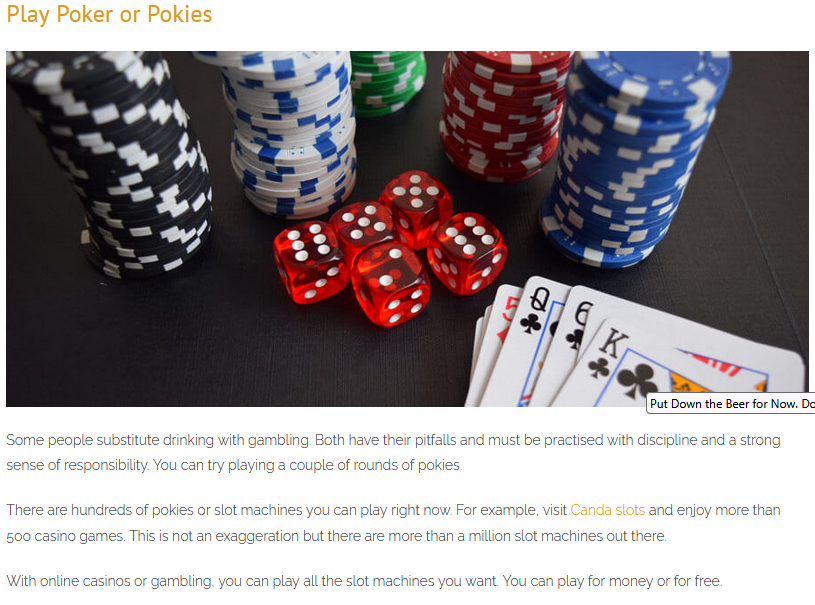
Is your highly addictive and detrimental hobby getting you down? Why not try a different highly addictive, detrimental hobby? Enjoy responsibly!

At this point I’m fairly certain that this is a grift and online gaming is the point of it. But at the same time, building multiple fake beer websites for the purpose of funnelling what can only amount to a handful of people to gambling websites just feels too, baroque.

I’m still pondering the URL. It has to be important somehow. Finally, something occurs to me: it’s a .nz. There’s an online function called a whois search. Essentially, you can enter a web address into a whois page and find out who has registered the domain.

Usually this will only tell you which domain company a website is registered with. I had done it with rosswalton.com, and gotten nothing useful back. But .nz domains are a bit different. There’s a database kept by the New Zealand Domain Name Commission of all websites that end with .nz, which contains more information than other online whois databases. And it’s searchable at at dnc.org.nz.

I plugged organicbeer.co.nz into the search box and immediately I had two new pieces of information: a name, and a company.

Which I will not share with you. The reason for this is pretty simple. I’m 99% sure that for the first time in this post, I’m actually talking about a real person. Which is to say I think Ross Walton is fake, but this guy and his company are definitely real. On the one hand, everything I’m writing here is publicly available information. Nor am I accusing anyone of anything illegal or even particularly unethical. On the other hand, I don’t want to bring any kind of heat on this guy, or invite it into my life. If you really want to know those details, they’re there for the finding.

So this outfit is an SEO company out of Ukraine. SEO stands for Search Engine Optimisation. To put it simply, SEO covers ways in which website owners attempt to push their website to the top of search engine results, thereby getting more people to visit their site. It’s one of those incredibly important but also very boring things that has massively shaped the way the internet works.

For the first time ever, I feel like I’ve hit bedrock. This has to be the answer. I just have to make the final connections. I spent a lot of time tracing the online footprint of this guy and his company. But I couldn’t track it back to beer or New Zealand. Eventually though, I found it on what I would describe as a slightly skeezy-looking Vietnamese tech website. I found an article that mentioned both him and his company extensively. It was Vietnamese but as soon as I had translated it, I knew I’d found the answer. The Rosetta Stone that made everything else fall into place:
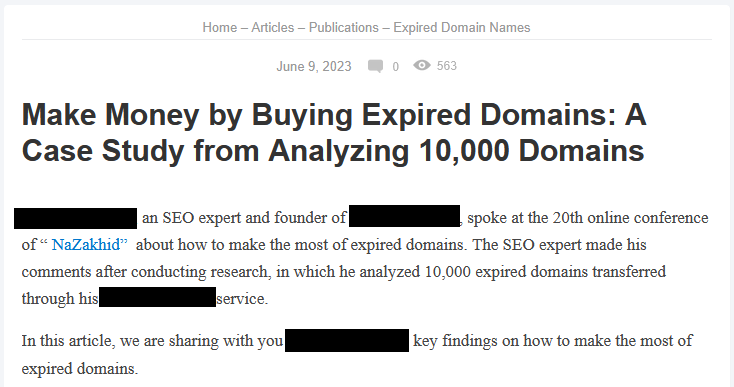
Details are censored, obviously.

Bingo. Cracked it.

This piece is essentially a report on a presentation this person made to a tech conference, laying out how this company makes money from expired web domains. The translation was a little patchy, but the gist of it is summarised here:

Basically what they do is buy old website addresses for cheap and fill them with content. That content drives views, thereby increasing the value of that web domain to companies that want to sell you something. That domain can then be on-sold to said companies at a higher price.

That’s what’s happened to organicbeer.co.nz. Mike’s Brewery dropped the domain back in 2018, and it was re-registered by this company in 2020. I even spotted this little nugget of info that more or less confirmed my deepest suspicion:

I’m pretty sure that’s why organicbeer.co.nz feels like AI slop: because it is.

Mystery solved. Unwittingly, I’ve probably added a few cents worth of value to the domain name with the several hundred clicks I made researching this article. You can see now why I haven’t linked directly to the website. And I’ll say to you now: don’t go there either. There’s no point.

I still haven’t figured out how exactly online gambling fits into this. My best guess is that it’s some sort of affiliate marketing program. If you click on that link, that referral is recorded. If you then go on to make a purchase on that website, the original website gets a cut for that referral. Across 10,000 websites, it might be a viable revenue stream. I am however, speculating here.

I’ve been writing all this up for a couple of weeks, and looking back I feel a little deflated. I’m happy I figured it out, but mysteries are almost always more exciting than answers. I’m left with a question: why did I get so obsessed with this that I sent literally hours searching for the answer?

Partly it’s because I can’t resist the chase. Like a foxhound, once I had the scent I just had to keep going until I’d run it to ground. But there’s something else that’s been bothering me that took me a while to figure out.

I’m a certain vintage of ‘craft’ beer person. I came up in the late 2000s, and back then ‘craft’ beer was these folks we knew: we were mostly all friends, or at least friendly collaborators. We drank in each other’s bars, visited each other’s breweries and attended each other’s events.

Someone and unfortunately I don’t remember who, once described the era as being like the early days of Britpop: going down to Marchfest from Wellington was like Blur going from Sheffield to Manchester to see an Oaisis gig. You knew you’d run into the Gallaghers at the Sprig and Fern afterwards.

That started changing as the industry grew and matured. Frankly it needed to and that was partly why I started this blog. Even though I’m not behind the bar anymore, I do still have something of a fraternal relationship with the ‘craft’ beer industry. People like Søren Eriksen from 8 Wired are still friends, who I’m always happy to see.

So when I see their names and businesses being used by something that seems like a scam, I don’t like it. Now it turns out that’s not really the case. As I said, there’s nothing illegal happening here. I also don’t think anyone has or will be harmed by this website, except maybe a couple of tourists left wandering around Auckland, looking for breweries that don’t exist. But it still just doesn’t sit right with me.

Rather than end on a down note, here’s something a little cheerful: proof that AI still has not and may never supplant human beings. It’s my favourite AI-oopsie from this whole experience:

Armpit. Bowling.

You’ll have to try harder that, GPT.

What the Hell Happened With Moa?

On Friday February 19 it was announced that Blenheim based Moa Brewing was to be sold. This was not exactly a surprise to a lot of people. For reasons that will become clear, many people had speculated that Moa was at least passively seeking a buyer, and had been doing so for quite some time. What was surprising was who bought it and for how much.

Current Moa CEO Stephen Smith has bought the brewery via his company Mallbeca Limited for $1.9 million, which is (and this is the technical term), a pittance. By my reckoning, the value of the site the brewery sits on must account for a decent chunk of that $1.9 mill. Factor in the other assets – the brewery plant, the taproom and stock on hand (including a barrel program), and the sale price would seem to barely cover the physical assets of the business. What this makes clear is that the Moa brand and all its associated ‘goodwill’ has been sold for essentially nothing.

When Moa floated their IPO in 2012, they offered 12 million shares at $1.25, representing 37% of the company. By my math, that valued the company at $40.5 million. This begs the question: How can it be sold for less than 1/20th of its value nine years later? What the hell went wrong?

Source.

The answer is not entirely straightforward. There were a string of strategic decisions and occurrences that lead to Moa’s downfall in my opinion.

Let’s go back in time to 2010. Moa is a small brewery run by Josh Scott, son of notable winemaker Alan Scott. In August of that year the company was bought into by The Business Bakery, an investment firm started by Geoff Ross, flush with money from the sale of Ross’s vodka brand, 42 Below. This was widely discussed in beer circles at the time, but didn’t make much of a splash in the media. The only article I could find referencing Ross’s buy-in was this one, about a queer-phobic marketing campaign the brewery ran. Which is funnily enough, the harbinger of what was to come.

In researching this article, I found myself deep in Moa’s social media feed. The change in tone from pre-Ross involvement is stark. For all of 2010, through to September most of Moa’s Facebook photos are of their products, their brewery, the fit-out of their tasting room and Josh Scott knocking about having a good time. Come November, they launch a new t-shirt promotion:

Source.

I’m not going to re-litigate the banal bigotry of this campaign. What I will say is that it didn’t feel like the Moa we knew. It felt different and it felt ugly. Scott distanced himself from the campaign:

Moa Brewing Company director Josh Scott, of Blenheim, said he knew nothing of the marketing campaign until he saw posts about it on the internet.

“Absolutely not. We have a whole Auckland office now.”

Source.

That line is telling: this change of course wasn’t coming from the brewery. It was coming from the Auckland marketing team. Moa didn’t continue the campaign, but they didn’t exactly distance themselves too far from it either:

Moa Beer marketing manager Sunil Unka, of Auckland, was unavailable for comment yesterday, but a spokesman told gayNZ.com the company was concerned the campaign had offended gay people.

Moa had not received any direct complaints about the T-shirts, but has offered to send some to the organisation.

Source.

Tellingly, Moa did not remove any of the posts from their Facebook. They would also post pictures of Moa employees wearing them a year later.

The low-carb campaign signalled a change in direction for Moa. But this change didn’t really kick into top-speed until they launched their rebrand in 2011. The change in the tone of their Facebook is abrupt. Looking back at their feed, you can almost hear the gears grind as they change direction.

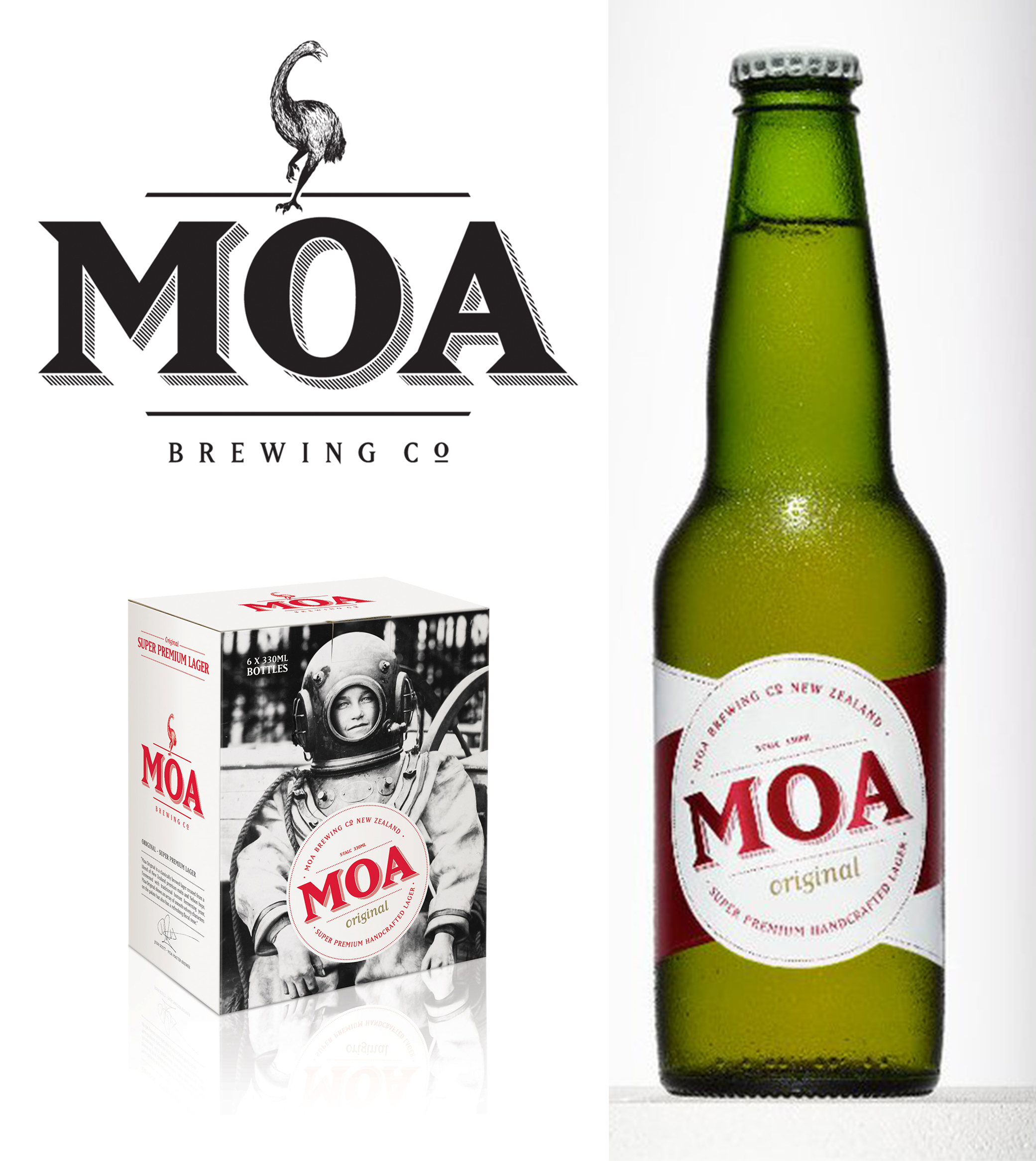
The decision to rebrand was outwardly a good one. Moa’s identity up to that point had evoked it’s winemaker heritage and it was somewhat fragmented and kind of stuffy. By contrast, the new brand was modern, sleek and fairly well integrated:

The problem wasn’t with the rebrand itself, rather the marketing strategy that came with it. I would describe it as a three pronged approach:

  1. Target a male audience.
  2. Make the Moa brand as visible as possible.
  3. Focus on the export market internationally and the supermarket trade locally.

In each one of these points, we can see a piece of Moa’s downfall. Let’s start with the first one. Moa’s decision to target an exclusively male audience was immediately clear from the get go. In 2011 shortly after launching their new brand, Moa put out a series of online ads, explicitly appealing to men. Here is a representative sample:

On the surface, a brewery appealing to a male audience might make sense. After all, it’s what most mainstream, corporately owned breweries do. Is not the Speight’s Southern Man one of the most iconic kiwi beer ad campaigns ever?

The thing is, targeting such a select audience is something most ‘craft’ breweries don’t do. There’s nothing overtly masculine about Garage Project or Parrotdog. Even Panhead, a brand which evokes traditionally masculine tropes such as motorcycles and hot-rods, doesn’t do so in a manner that explicitly excludes women as a consumer. But that was the approach Moa took. And spoiler alert here: Panhead is going to come up a lot in this story.

What I would call Moa’s latent misogyny became straight-up overt misogyny when they prepared to float the company on the share market, and launched their Initial Public Offering (IPO). This was essentially a prospectus to potential investors, the full title of which was (and I wish I was kidding): “Moa Group Limited Initial Public Offering Investment Statement: Your Guide to Owning a Brewery and Other Tips For Modern Manhood”.

Via the Beer Diary.

A huge quantity has been written about this document. For a rundown of the highlights, including the full PDF of the IPO, I recommend reading this post on The Beer Diary. The only mention of women as potential consumers (not even investors) is in the whole document is in this section here:

Brewers find cider is popular with female and gluten-free consumers. These groups are often complementary to brewers’ traditional sets of consumers and present a new market opportunity.

Moa IPO, p.91

Most explicit of all was this quote from an article which interviews Ross about the document:

[Ross] said the prospectus was targeted at Moa’s prospective investors who were largely the same demographic of young and middle-aged, aspiring, affluent men who drink the product.

Source.

Where this is all a strategic blunder is that it sections off the potential market for Moa beer into a needlessly small demographic. Sure, some women (and other people of different gender expressions) wouldn’t care, but others would and as a result, have since declined to purchase Moa’s products. They’ve been alienated for essentially no real gain to Moa.

This brings me to the second part of Moa’s marketing strategy: making Moa as visible as possible. There are two parts to this plan, the first of which ties into their choice to market to a male audience: Controversy for controversy’s sake.

If you think the low-carb campaign and the IPO were the only time Moa courted controversy, you’d be very wrong. Over the years, there was a cavalcade of needlessly provocative advertisements. It started with the “Finally something drinkable from Marlborough” ads:

Via Moa’s Facebook.

What was on the surface a cheeky dig at wine producers (including Josh Scott’s father and the winery that made Moa possible), was also something of a middle-finger at other Marlborough breweries, such as Renaissance.

Then came the awkward flirtation with gang imagery, including (briefly) naming a beer ‘Black Power‘, a gang-patch style logo, and bizarre, black power themed tap handles that looked very much like l sex toys:

Then there was the bafflingly non-nonsensical return to homophobia:

The absolute peak of bullshit controversy-seeking would be the infamous Pakistani Backhander campaign, which I’m not even going to share here (you can find images of it online if you want). Suffice to say, it blended pretty overt racism with again, some weird homophobia, by way of a crude Photoshop job.

And I’m only scratching the surface here. There were many more posts and campaigns designed to garner the brewery attention, which failed to take off. It got so ridiculous that at one point I wrote a parody Moa campaign, which was taken by several readers at the time to be the real thing. As a weird coda, it accidentally found it’s was into a Spinoff article on the same subject as this very post!

The article has since been amended. The fake ad is on the left. The ad on the right was real.

Now there is an adage “There’s no such thing as bad publicity”. Geoff Ross clearly subscribes to this belief:

With recent newspaper headlines such as “Breakfast beer slammed by critics”, “Cashing in on wine’s good name” and “Gay community offended by Moa Beer campaign”, it’s a good job Moa’s new boss, marketing guru Geoff Ross, believes there’s no such thing as bad publicity.

In his book, Every bastard says No, the man who gave the world 42 Below vodka and is now backing Moa gives his key insights into successful marketing.

High on the list is “At all costs get noticed. Be heard. Stand for something”. Judging by the amount of news coverage Moa has been attracting in recent weeks I’d say he’s doing a very good job!

Source.

As someone who was working on the front-lines of craft beer at the time this was happening, I’d have to disagree. The abrupt change left a bad taste in many mouths. It was cheap, inauthentic and ugly, the exact opposite of what we knew and loved from Moa. The end result was that they lost some important customers.

Myself and a lot of my friends stopped buying Moa, and we told our friends not to buy it either. Both bars I have worked at declined to pour Moa beer. I know other bars around the country did the same. As a result, Moa alienated the very people who had up to that point been their biggest evangelists: existing craft beer drinkers. Now hold onto that thought because it’s going to be relevant again later.

For now I want to change course and talk about the other important aspect of Moa’s strategy to increase their brand visibility – sponsorship.

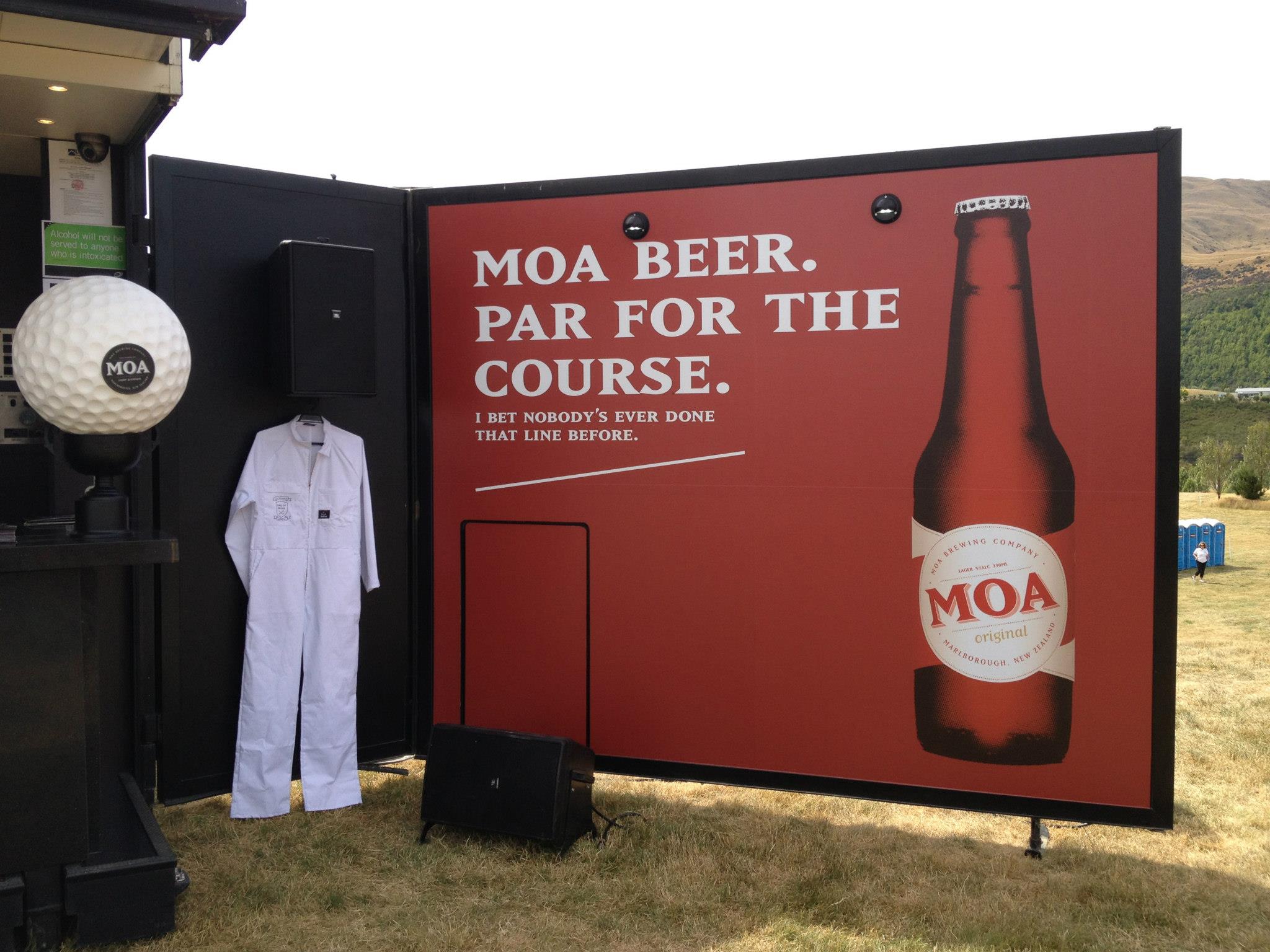
Post Ross’s buy-in, Moa embarked on a staggering amount of sponsorship campaigns: music festivals, dirt biking, showjumping, golf, yacht racing, a rabbit hunt, the Olympics, a trip to Antarctica, The Americas Cup. If they could put their logo on it, they did:

Scrolling through Moa’s Facebook, one of the things that struck me was the literal millions they spent on sponsorship over the years. Now sure, you’ve got to speculate to accumulate. But at the same time, the company posted years of multi-million dollar losses starting in 2012 right up until 2020. Moa losses were such an industry talking point that local satirical site Too Much too Beer wrote a piece about it. With the company losing millions annually for nearly a decade, it begs the question: Maybe you should’ve sponsored fewer yachts?

All this very expensive promotional work realistically was in service of one thing; our final prong of the business strategy: focusing on export and supermarket trade. Right from the get-go, Ross let it be known that he wanted Moa to be New Zealand’s foremost beer-brand internationally. In an interview with interest.co.nz, he said the following:

Every country has an iconic beer brand and we want Moa to occupy that space in the future. Right now there’s clearly a gap in the market for a beer like ours and we believe the combination our branding and our brewing technique to create a high quality product with a long shelf life are what sets us apart. So we think we have all the founding principles to create a really iconic international beer brand right here in NZ.

While we do want broad consumer recognition domestically I would prefer to achieve the sort of success and positioning that Cloudy Bay has gained for itself where around 80% of its product is exported but it is also highly regarded domestically. So in an ideal world we want Moa to become the Cloudy Bay of craft beer.

Source.

Ross wanted Moa to not just recognised, but the most iconic beer in New Zealand. That means one thing: unseating Steinlager, something acknowledged in the same interview:

“While Steinlager has achieved some good success previously, there’s always been the problem with the German name and their primary focus has been principally on the domestic and Australian markets. For us it’s the reverse. We see the US & UK as our primary markets because that’s where the growth will come from while simultaneously retaining a strong focus on our domestic market here.”

So while Steinlager may have once conceived that catchy positioning line “… they’re drinking our beer here” the phrase might be more appropriately attributed to Moa in the future if those backing its high profile listing have their way.

Source as above.

First off, relying on export of beer is an inherently risky proposition. Beer is a lot less stable than wine – it’s more heat sensitive, and has a shorter shelf-life. Selling overseas involves a lot more effort too. Invariably a distributor is needed which involves slows down the whole process and adds an extra company taking a cut of the profit. Ross repeatedly mentioned the US market as a goal. What any beer geek could have told him at the time was that selling beer to the Americans is very much selling sand in the desert.

Export markets are also very fickle. I’ve seen on multiple occasions, breweries offering substantially discounted beer to the New Zealand market when export orders consisting of whole container loads are cancelled at relatively short notice. So while many ‘craft’ breweries do export beer to one degree or another, I struggle to name any brewery that relies on it to the tune of the 80% mentioned by Ross.

Indeed Moa quickly came to realise this, and by 2014 were discussing difficulties with the US market. This in some ways is what precipitated the shift to the local supermarket trade. And around this time, drinkers would have seen a lot of very cheap 12 packs of Moa Methode. By 2016, Moa were proudly claiming to have 11 percent of the supermarket trade.

Here’s the thing about supermarket beer sales: They’re inherently high-turnover with low margin, particularly when you’re dealing with the bulk, 12 pack lager market. Most people shopping in this segment will buy whatever is on special. By focusing on this sector, Moa was directly going up against Lion and DB, in what is essentially a volume game – who can sell more, cheaper. The problem for Moa is fairly succinctly summed up in one of their own (and frankly better) ad campaigns:

Via Moa’s Facebook.

That’s a fairly accurate picture of the situation for Moa. They were attempting to go toe-to-toe with Lion and DB on their own turf. Lion Nathan (owned by Kirin) is the biggest producer of alcoholic beverages in the country and it’s primary production facility The Pride produces hundreds of millions of litres of beer every year, and DB, owned by Heineken is not far behind. Moa was never going to win that fight.

While cracking the off license market is really important, and has been pivotal to the success of breweries like Parrotdog, Garage Project and Panhead, those breweries also worked hard to maintain their ‘craft’ beer bona fides.

Remember how I mentioned the Moa had alienated a decent chunk of existing ‘craft’ beer drinkers, including several who owned or operated bars? Well those relationships are actually quite important. A busy on-license, even one that rotates its taps can turnover tens-of-thousands (if not hundreds-of-thousands) of dollars of beer from a single brewery. What’s more, on-license sales can often drive higher off-license sales. After all, drinkers are less likely to invest in a 12 pack of a beer they’ve never had. But that reticence isn’t so high when it comes to buying a single beer in a bar. So if a customer enjoys a beer in a bar, not only are you building a stable relationship with on-license customers, your investing in future supermarket sales later on.

So while the aforementioned Parrotdog and co were working hard to sell in supermarkets, they never forsook the traditional ‘craft’ beer on-license trade. This is something Moa kind of came to realise down the line. At the 2019 investor AGM, Ross said this:

Selling beer at the supermarket isn’t a magic bullet and doesn’t drive gross margin.

Source.

Moa would go on to invest in various Auckland hospitality businesses by purchasing the Savour Group, and when it came time to shear-off the unprofitable brewery, the Moa Group essentially morphed into a hospitality company. Or if I was being cynical, I’d say the corporate leadership transplanted themselves onto profitable hospo co, throwing the brewery under the bus, but I digress.

At this point, the picture should be pretty clear: Moa was spending a lot of money on their brand, investing very heavily in anything that would raise their profile but they were not actually building a stable, sustainable or even particularly functional brewing company. Nor do I think they really ever intended to.

To say they were intentionally losing millions of dollars a year wouldn’t be accurate. Rather I’d say they didn’t mind sustaining those kinds of losses for the first few years because they didn’t intend to be running Moa for very long. I believe that from very early on they planned to sell the Moa to one of the larger brewing companies. After all, this is exactly what happened with the company that made Ross a multi-millionaire: 42 Below Vodka.

I don’t want to go too deep into the history of 42 Below, least we get sidetracked. You can read all about it in Ross’s book. I will say Ross did start it from scratch in 1998, and that hard work and achievement deserves acknowledgement. Having steadily grown the business for seven years, the company was sold to Bacardi for $138 million.

What is pertinent about 42 Below is how they marketed it: controversy. Oodles of it. As much as they could get. And that was fine for selling vodka, but ‘craft’ beer is a different game. For starters and as I mentioned, beer is an unstable product. Make too much and you either have to unload it cheap, or pour it out. Make too much vodka, and it will keep literally forever.

What’s more, and this is where we’re really getting to the crux of what went wrong for Moa, 42 Below was essentially the only vodka game in town at the turn of the millennium. By contrast, Ross was stepping into an already crowded beer market. The same year Moa launched their IPO, Lion was already making their first modern craft beer acquisition – Emerson’s Brewery.

The sale of Emerson’s to Lion for $8 million may well have spurred on Moa, After all, they’d shown they were keen to acquire independent brewers. Why couldn’t Moa also attract a multi-million dollar deal from the brewing giant? The trouble is, while they were busy tarting themselves up and making eyes at Kirin, something else was coming up behind them. Something unstoppable, powered by a supercharged-V8 engine, and going a million-miles-a-minute: Panhead.

To say Panhead killed Moa would be an exaggeration. After all, Moa died a death of a thousand cuts. But the story of Panhead must be a cut felt particularly deeply. Started in 2013 by former Tuatara brewer Mike Nielson, right out the gate their popularity and growth was staggering. The flagship beer, the very hoppy Supercharger APA was the darling of the Wellington ‘craft’ beer scene, but was also one of the first hoppy beers to find huge popularity with everyday drinkers. I vividly remember a customer coming up to the bar, circa 2016 and saying “I don’t like craft beer… do you have Supercharger?” When GABS launched their annual Hottest 100 Kiwi Craft Beers List, Supercharger came top in 2016, 2017 and 2019, as well as 3rd in 2018 and 4th in 2020.

Panhead galloped away and was sold to Lion in 2016, only three short years after it’s founding. The total sale price was $25.1 million. Lion described Panhead as “a runaway train” and “[Panhead] can’t keep pace with demand.”

Now where all this is a problem for Moa, is that it effectively took Lion off the table as a prospective buyer. After all, why would they want to buy an unpopular and unprofitable brewery when they already had two very successful brands in their portfolio?

OK, there’s also DB, New Zealand’s second largest beverage producer. Well, in 2011 they had started their own faux-‘craft’ label, Black Dog Brew Co. to moderate success. Then in early 2017, they bought Tuatara Brewing for $30.2 million, effectively taking them out of the equation as well. This left pretty few options for Moa.

There was always Independent Liquor (owned by Asahi). They had bought Duncan’s Founders in 2012. The success of that acquisition has always seemed somewhat flat. While Founders has become a supermarket staple, it’s never quite risen to the prominence of even Independent’s other faux-‘craft’ label Boundary Road. Independent has not made any moves that would indicate they would want to buy another brewery ever since.

After that, the field gets kind of thin. There was Constellation Brands, a massive American brewing concern with a subsidiary in New Zealand. They bought San Diego based brewery Ballast Point for a staggering US $1 Billion in 2015.

Indeed for a hot minute, it looked like something might be happening there. A distribution deal was set up in 2018 that would see Moa distributing Ballast Point in New Zealand. There was talk this could presage an acquisition. Come 2019 though and supermarkets were selling short-dated cans of Ballast Point at heavily discounted prices. Later that year, Constellation would unload Ballast Point to a virtually unknown brewer in Illinois for a measly US $8.55 million, in a move somewhat reminiscent of Moa’s sale this year.

At this point, things were looking dire. There was always Coca-Cola Amatil. They had bought Feral Brewing in Western Australia. Might they want to get into the New Zealand beer game? Well they did, by signing a distribution deal with relative newcomer Fortune Favours in 2019.

The clock was ticking. Every year Moa went unsold, they racked up multi-million dollar losses and options to sell were running out. Moa had built an essentially toxic brand. Their turnover was high-volume, low-margin and their primary customers were fickle supermarket lager drinkers, more interested in value than quality or loyalty. They were bleeding money and their list of potential buyers was looking very short. It’s not impossible that there was still someone out there that might wish to acquire a New Zealand brewery, but even then Moa probably wouldn’t be top of that list.

Then Covid-19 arrived and the world changed. With massive global uncertainty, it’s hard to imagine any company wanting to shell out tens of millions to acquire a struggling brewery. I have to suspect the global pandemic was the final nail in the coffin. Moa had to be cut loose, lest it bleed them dry. Which brings us up to today.

Moa’s future is uncertain. It may rise again under new ownership, maybe it will go back to it’s regional roots and be just another local brewery. Or possibly will fade away like its extinct namesake. I do know that the former Moa Head Brewer (and top-bloke) Dave Nichols departed the company late last year to start his own brewing operation in Marlborough. I greatly look forward to what develops there.

I often like to wrap up my writing with a “what did we learn?” reflection. Looking back I think Moa’s strategy was a poor one from the start. Getting to the point where you could be sold should never have been the goal. Building a stable, sustainable business should have been their primary aim. If they had maintained their integrity with the existing ‘craft’ beer market and used that as a foundation for their growth, things may have panned out differently. To that end, perhaps the takeaway should be “don’t be a dick?” It would be a fittingly kiwi lesson. That, and perhaps “sponsor fewer yachts?”

How to Name a Brewery

With so many new breweries opening in recently and no doubt more opening in months to come, there’s a discussion we need to have: how to name breweries and beers. This post is going to be related to the former rather than the latter (I’ll write that next). Both I think, are very important, because of one simple truth:

A good name attracts customers and sells more beer. A bad name discourages customers and will lose you sales. 

This is a simple fact that I’ve observed from almost six years of selling beer to the public. There are also quite a few pitfalls that new breweries can fall into when it comes to naming themselves and their beers.

Now I know what you’re thinking and I totally agree: surely the quality of what’s in the glass should be more important than what it says on the label. Yes, it should. But getting your beer into the hands of first-time customers is also important. You want your brewery name to stick in someone’s head and, if your beer impresses them, you can create something valuable – a returning customer.

It’s true lot of brewery names come from stories. Stories are good. Stories help build a brand. ParrotDog was founded by guys who owned a parrot and called each other ‘Dog’. That’s great. But stories are not what I want to talk about here. I’m more interested in the mechanics of what makes one brewery name work better than another.

I had originally intended for this post to list some hard and fast rules of how to name breweries The more I thought about it, the more I realised how much of this is subjective. But in my six years I’ve poured more beers than most people will drink in a lifetime. There are certain things about brewery names that I see trip-up customers time and time again. Here are a few, what I guess you’d call ‘guidelines’ to avoiding some of the major pitfalls of naming a brewery.

No offence to any brewers I use as examples. Firstly this is no reflection on the quality of your beer. Secondly, quality of beer is ultimately more important. A bad brewery name is no reason to turn your nose up at a good beer. Third, if you’ve had your name for years and you’re doing just fine, then by all means ignore this post. This is more directed at the newcomers. Alright, let’s do this. And we’ll start with perhaps the most important point first.

1. Keep it Short

Short is good. Short is dynamic. Short is easier to remember. Brewery names need to be direct and to the point. It should be one or two words, three at most (but only if one of them is ‘and’ or ‘the’). This doesn’t include the words ‘Brewery’, ‘Brewing Company’ or similar, which naturally get sliced off the end in conversation. Nobody ever refers to Brew Moon by its full name: ‘Brew Moon Brewing Company’. Brew-Moon What I consider to be good brewery names are a handful of syllables that roll off the tongue and are away: ‘Liberty’, ‘8 Wired’, ‘Three Boys’. These are simple words that you can say without tripping-up over. There’s a very good reason for this – when written on beer labels, tap badges or menu boards or spoken to bartenders, brewery names sit in front of a beer name. Let’s take an example: 8 Wired Hopwired IPA – Good. Quick, easy, to the point (some people don’t like the repetition of ‘wired’ in the name, but that’s a different discussion).

All G.

Everything as it should be.

Sometimes however, customers get confused about this name and refer to 8 Wired as ‘Number 8 Wired’ or occasionally ‘The Number 8 Wired’. Fair enough, it’s an easy mistake to make as the name originates from number 8 wire. But for argument’s sake, let’s give that a go. The Number 8 Wired Hopwired IPA – Bad. A clunky mouthful.

This is why we can't have nice things.

This is why we can’t have nice things.

Beer names can already lumbering enough, if you’re going to hitch it to an already difficult brewery name, you’re not doing yourself or your customers any favours. But how long is too long? Hard to say. Two breweries that I think are pushing acceptable limits of syllables are ‘Garage Project’ and ‘Beer Baroness’. I think both get away with it, Garage Project because it has a nice structure, and Beer Baroness because it has alliteration, but that’s just me.

2. Names of People/Places are Perfectly Acceptable

There are quite a few breweries named after the brewer. Sometimes it’s a first name, like Mike’s or Dale’s. More frequently, It’s a surname:  Townshend, Gailbraith’s, Croucher, Harrington’s, Emerson’s, Fitzpatrick’s, Cassels and so on. Very rarely, it’s both first and surname – I’m looking at you, Ben Middlemiss.

Perfectly fine. Except maybe the 'Crisp'...

Perfectly fine. Except maybe the ‘Crisp’…

Likewise, place names are commonly used: Invercargill, Baylands, Coromandel, Hot Water, Kaimai, Queenstown, Arrow, Waiheke, etc. This is also a good option, although I guess it might reduce your options of changing where your brewery is (Baylands is not on Baylands Road anymore). Personal or place names are perhaps the least interesting way to name a brewery, but they are basically functional. I think names like these are a good option because they usually obey rule 1. – They’re short and informative. Although, as I type this I realise I shall never found a ‘Jauslin’s Brewing Co.’ as no Anglophone can ever say it properly…

3. No More Dog Breweries

Animal names are another popular choice, and seem to work fairly well. They also tend to be short and to the point. Some go simple – just the animal name. Tuatara, Moa and Kereru fit this bill. Others, like to use what I call the ‘Indie Band’ approach. A trend in recent years amongst indie bands is to use a something-animal’ name. Hence: Modest Mouse, Fleet Foxes, Frightened Rabbit, Wolf Parade, Tame Impala, Arctic Monkeys, Band of Horses, Grizzly Bear, Deerhunter, and so on (it’s a regular Animal Collective).  Similarly, in the brewing world, we have Golden Eagle, Golden Bear, Monkey Wizard, Velvet Worm, Pink Elephant, Crafty Trout, and I could go on. Animal names are a good option, with one notable exception: Dogs. You see the problem is, people come in and say “I want that ‘Dog Beer’ please,” and I really can’t help them because in New Zealand, we have:

That may not seem like many but they may, even in the New Zealand context reasonably also be referring to:

  • BrewDog (Scotland)
  • Moon Dog (Australia)
  • Flying Dog (USA)
  • Dogfish Head (USA)

I’m officially marking New Zealand as above quota on ‘dog’ breweries. No more guys, we’ve got too many already. In fact a search for ‘Dog’ on Untappd brings up 760 brewery results. Forget New Zealand, the whole world has too many dog breweries.

4. Jokes Get Old

So you’ve come up with a clever pun or something, and you think you’re going use it to name your brewery. That’s cool, but keep in mind one thing: you will be repeating that joke again, and again, and again. It gets less funny every time (this is known as The Bee Sharps Effect). Now this isn’t an issue if the name works well regardless of the joke. I’m thinking of Yeastie Boys here. “Yeastie Boys! Haha, it’s a music-themed brewery riffing on The Beastie Boys!” But underneath that joke, I find ‘Yeastie Boys’ to be a nice, short, chewy-sounding name. YB But what if the name isn’t so good? Well then the joke just sits there being repeated, again and again. And it’ll be repeated a lot. It’ll be tacked on the front of every beer you brew. It’ll be plastered on menu boards and tap badges. You will never escape it. Fork & Brewer, I’m looking at you guys. The Cameron Slater school of humour. Yeah. Nah. Sorry Sean, Colin, Neil and Kelly. I really like your beer, but I think you should have stuck with Bond Street Brewery.

5. Choose Descriptors Carefully

A lot of brewery names have descriptive words in them – Pink Elephant, Wild & Woolly, Fat Monk and so on. These are all fine. But choose your words carefully, because if you include a descriptor in your brewery name that frequently applies to beer, many customers will automatically assume that descriptor applies to any beer you make. What do I mean by that? Well, let’s look at the two most common examples. First of all, ‘hop’. As in: Twisted Hop, Dr. Hops, Hopmonger, Hophugger, Hop Federation, Hop Baron, Hops Valley, etc. Besides being incredibly unoriginal at this stage, having ‘hop’ in your name can put off many inexperienced customers who see the word on a menu and automatically steer clear of it, because for whatever reason, they’ve decided they don’t like hoppy beer.

It might also be a time to call a moratorium on 'Hop' names as well...

It might also be a time to call a moratorium on ‘hop’ names as well…  Although three of these breweries are no longer operating.

Likewise, but perhaps for another reason, be wary of the word ‘golden’. As in Golden Eagle, Golden Bear and Golden Ticket. Inexperienced drinkers see the ‘golden’ on a menu and automatically assume the beer in question is a lager of some sort (the same but opposite may apply to the ‘black’ in Black Dog).

Think I’m kidding? I’ve had customers come up to the bar and ask me: “So this Golden Bear Seismic IPA, that’s like a Pilsner, right?” or “Golden Eagle Coalface Stout, that’s a lager, yeah?” Or they just order a Coalface (which is an awesome beer by the way) and look at me blankly when I put a pint of black beer in front of them.

Now I know ‘Coal’ signifies dark and ‘Stout’ should clinch the deal, but what needs to be understood here is that a large slice of customers, perhaps even a majority of the people who drink all the ‘craft’ beer in New Zealand, are not Beer Geeks. They may not know the difference between a Lager and a Stout. They may assume all Lagers are pale, and all ales are hoppy. They may have all manner of assumptions they have picked up or been taught over the years.

I’m not saying we need to pander to or talk down to this demographic (that’s patronising behaviour that breeds resentment). I’m just urging a bit of forethought as to as to how your brewery name will influence customer expectations.

6. No. More. Fucking. Dog. Breweries.

If you’re opening a brewery and you, even for one moment, consider giving it a ‘dog’ name, I will come around to your brewery, open all the valves on your tanks, and then beat you to death with your mash paddle. I don’t want to go to prison.

Please don’t make me.

The Worst Decision I Ever Made

"Investors seem willing to pay above market rates to buy into the
story of New Zealand craft beer." 
-Rob Simic, ANZ Commercial and Agricultural Regional Manager, 
Beervana Media Briefing Session, 2014.
"No-one will ever get a dollar back, so i [sic] really hope we 
don't hear them moaning about it down the track. It's a worse 
investment than a finance company debenture!" 
- C N, Comment on an NBR Article

Investing in Yeastie Boys is without a doubt one of the worst decisions I’ve ever made.

OK now to qualify that statement. No doubt if you’re even remotely connected to the New Zealand beer scene you’ve heard the news: Yeastie Boys raised half a million dollars in 26 minutes via crowd funding. Let’s all take a moment to appreciate that feat.

1423168872126

Done? Right, now lets talk about how disastrously, ruinously mad it is.

The occasion has special significance for me for two reasons: first of all, the launch party was held at Golding’s, and I was working it. I’ve bartended many monumental occasions, including the launch of ParrotDog and Garage Project, but this one may just take the cake.

The other reason it’s significant to me is that I’m one of the the 219 people that chipped in money. Yes, I foolishly ponied up my hard earned cash for a tiny slice of the Yeastie Boys pie.

It was not my intention after reading the share proposal, to invest in the company. Because lets face it, the below the line nay-sayers commenters on the National Business Review articles are correct. Economically, Yeastie Boys is a terrible investment. It’s not that the company is going to go down in flames. To the contrary I have very good reason to believe that it will soar, if not like an eagle, then at least like a fairly ambitious pigeon. No.

But the cold hard facts remain: Half a million only buys 12.5% of the company, which places a value on Yeastie Boys at ~4M, or in other words, somewhere between high and ludicrous. Considering this, and the relatively low-profit nature of brewing at any scale, no one will ever see a good (if any) return on their investment. It’s truly a terrible decision to invest in the Yeastie dream.

"How dumb are some New Zealanders?" 
- Reece of the Duchy, Comment on the same NBR Article

But here’s the thing – we, as in everyone who invested in Yeastie Boys, already knew that. So why the hell did I willingly, gleefully even, chuck my cash into a flaming black hole? Well, first of all, because I could.

I invested a cheeky $500. I could frankly take that much cash out to the BBQ right now and set it on fire (or burn it in one hundred other more creative and figurative ways). Whilst this would be a very foolish decision, at the end of the day, I could do it and still make rent.

And I suspect this goes for everyone else who also threw money in. The average investment was ~$2500. There will be many low level investors like myself, but also a few that invested much, much more money than that. But I also know for a fact that no one invested at a level which means they’ll have to foreclose on the family home if Yeastie Boys doesn’t immediately (or ever) start paying out big dividends.

Frankly, the only one who’s going to get seriously burned if this whole thing doesn’t work is Stu. And he knows that.

The other reason I invested in this thing comes back to something I wrote a few months back:

"I’d invest in a brewery because I believe in drinking good beer, 
and I want to ensure I can get a good pint for years to come. 
Expecting a return on buying into a ‘Craft’ brewery is to me like 
expecting a return on buying a pint at the pub. Passion and 
enjoyment are why we get into this industry, not striking it rich."
- Dylan Jauslin, Beervana is Decadent and Depraved Part #2

So here was the chance. Money where mouth is. And it’s been two weeks since then and in the cold light of day, I stand by that sentiment. I want more Gunnamatta. I want more Pot Kettle Black, and yes, I even want more Rex Attitude. I do not for a moment regret making the worst financial decision of my life. In fact I’d do it again, in an instant.

Fuck'n. Classy. Bastards. Credit: The Brewers Guild of New Zealand.

Stu and I at the BrewNZ Awards, 2013.
Credit: The Brewers Guild of New Zealand

***

Having said that, there is one thing I’m nervous of: other breweries.

I can feel them, right now, waiting in the wings. Those who have seen what Stu and Sam have done and are thinking of going and getting their own share of that sweet, sweet crowd-sourced money.

I know that people are thinking about it and I can tell them now – it won’t work out the same. It might seem like Yeastie Boys pulled this off in 30 minutes, but they have been building up to this for 6 years, and Stu has personally been working towards it in one sense or another for more like 10 years (ask him one day about the history of Liberty Brewing).

So think long and hard before you go out there and try to recreate what Yeastie Boys (or even Renaissance) have done. There’s no guarantee it’ll turn out how you want it to.

OK, lets end this on a positive note.

I have officially sliced myself a “piece of the Yeastie Boys pie,” as Anna Guenther of PledgeMe puts it. But frankly, I don’t feel like I have. I feel more like I’ve contributed a little dough (pun intended) to the amorphous mass, which will eventually be rolled out to make the crust of a really special pie.

And in this regard, I feel like I’ve been supporting Yeastie Boys from day 366. For that was the second ever launch of Pot Kettle Black, and the first time I ever had one of their beers. In a very simple way I feel like I’ve been supporting Yeastie Boys for many years the same way those who didn’t invest (or just weren’t quick enough) can support them. By going out and enjoying a Yeastie Boys beer!

Cheers, or as Stu says:
Sláinte Mhaith!

Credit: The Brewers Guild of New Zealand

Credit: The Brewers Guild of New Zealand